Thrare › Parking decks and structured parking
Decks cleaned in sections, so the deck never closes.
A parking deck is the one asset you cannot take offline. Everything about how we run deck work follows from that.
Thrare › Parking decks and structured parking
A parking deck is the one asset you cannot take offline. Everything about how we run deck work follows from that.
Parking deck cleaning is the washing, degreasing and drain control of a multi level or structured parking facility, carried out in sections so the deck stays open to vehicles for the duration of the work. Thrare Contracting performs commercial parking area maintenance across metro Atlanta, including parking garage cleaning, deck degreasing, stair core and elevator lobby cleaning, and parking lot striping with ADA layout. A four level occupied deck was cleaned in 4.5 days without closing, worked level by level while residents kept parking on it.
The constraint
A deck is a working floor with cars on it, drains that run to a system somebody regulates, and residents who need their space back on a schedule they can plan around.
Most deck cleaning fails for one of three reasons. The level is closed longer than anyone was told, so residents come back to a barricade. Wash water carries oil and heavy solids into a storm drain that was never meant to take them. Or the deck is cleaned once, looks correct for a month, and nothing is scheduled after that.
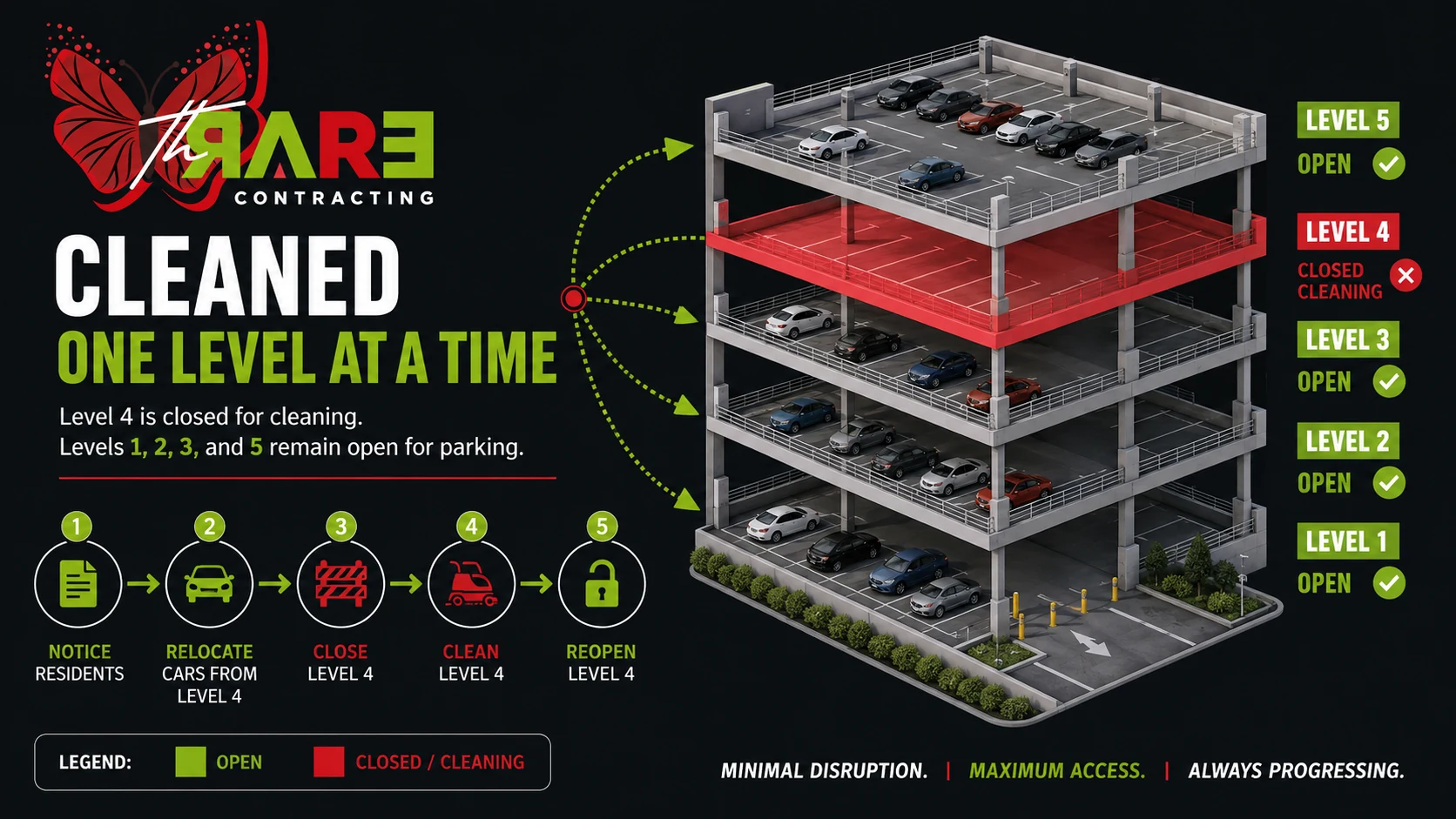
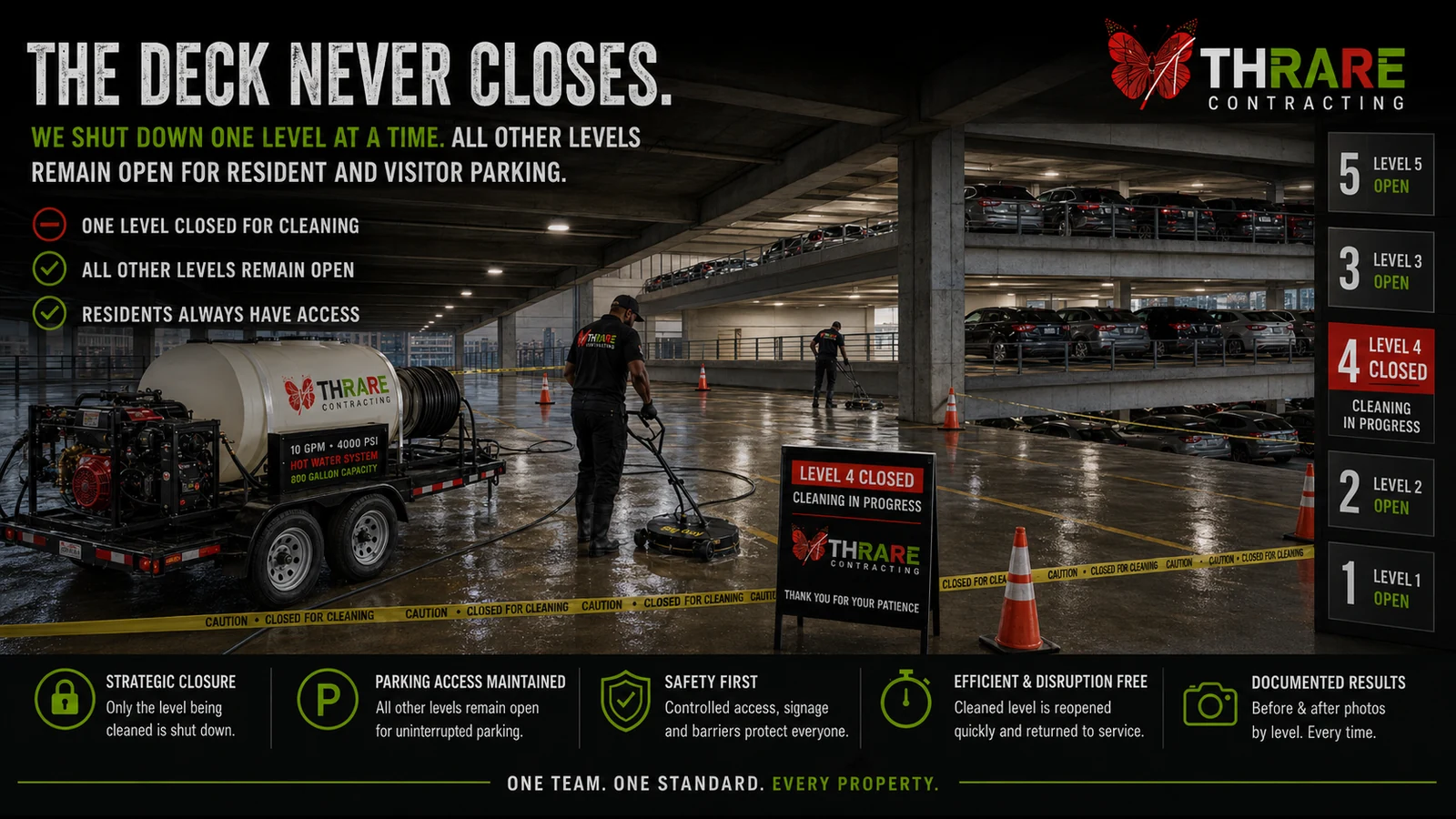
We plan a deck around the vehicles first and the surface second. The deck is taken in sections against a posted notice, cars are relocated a section at a time rather than all at once, and each section is handed back before the next one starts. A resident should never have to ask where to park.
The work
Deck work is rarely just washing. The oil, the stains at the stalls, the columns, the stair cores and the drains are separate problems that arrive together.
Hot water and surface cleaners across the slab, with degreasing worked into the drive lanes and stalls where oil has soaked in.
Four-level occupied deck, 4.5 days
The parts residents actually walk through, cleaned on the same visit so the deck does not read as half done.
Vertical surfaces and the painted elements that carry most of the visible grime.
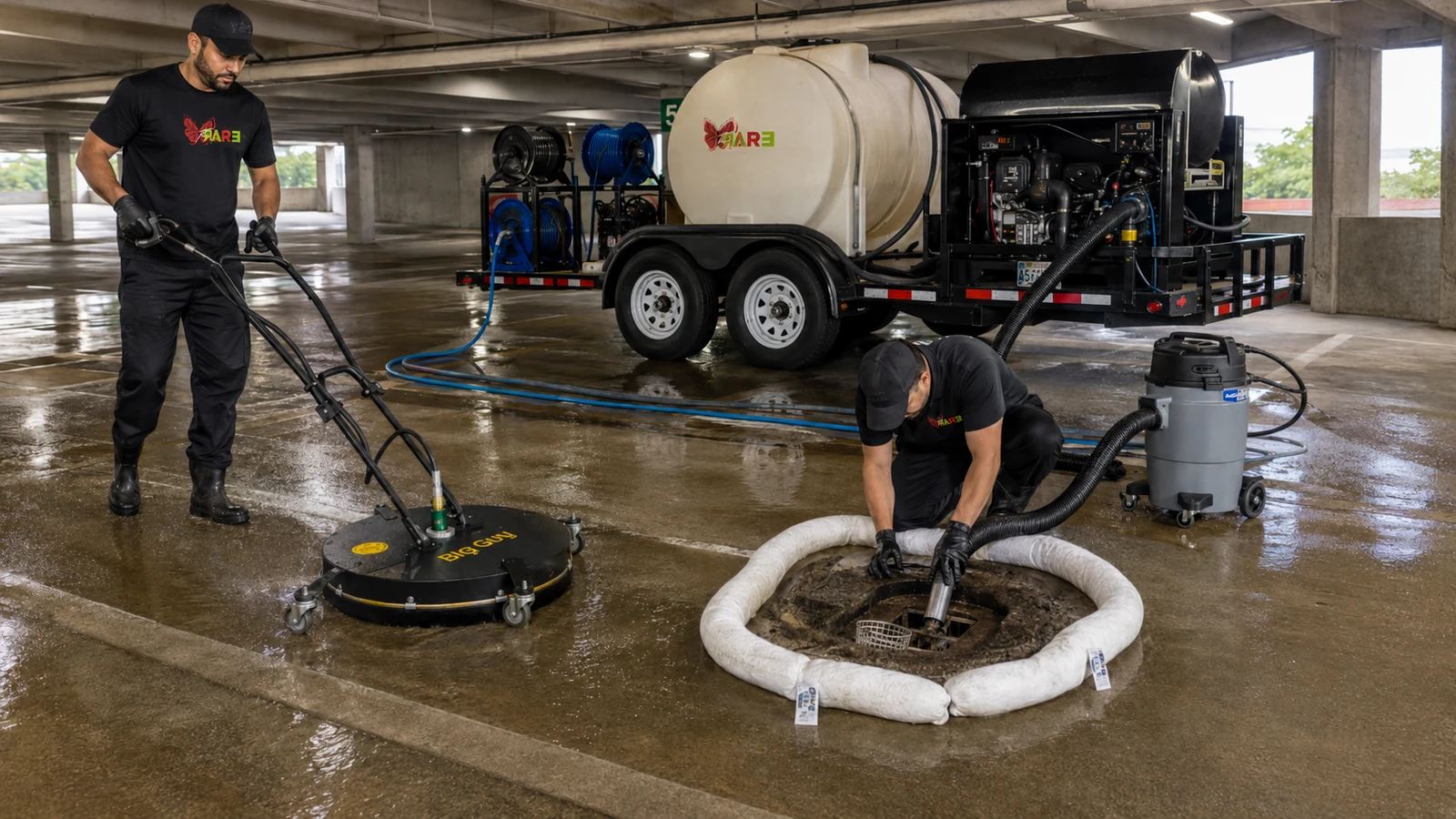
Wash water contained and directed, solids captured, so what leaves the deck is not carrying the deck with it.
How a deck runs
This is the sequence we commit to. It is what makes an occupied deck possible without a full closure.
Scope boundary
A deck quote that does not list its exclusions is not a quote. It is an opening position.
We put the exclusions in writing before the work is priced, because exclusions are where a second invoice comes from. Two scopes in particular get assumed into deck cleaning and should not be.
Traffic coating is a separate trade with its own material, cure window and warranty. A wash is what you do before a coating goes down, and what extends the life of one already down. It is not a cheaper version of one. Structural repair is not a cleaning scope either. Washing a deck routinely uncovers spalling, exposed rebar or a failed expansion joint that the grime was covering. We photograph what the wash exposes and hand it to you. We do not repair it under a cleaning contract, and we do not leave it out of the report because it is inconvenient to raise.
If your deck needs any of the below, say so at the walk. Some of it we can bring in and run under the same project management, which normally costs less than contracting it separately. Some of it belongs with a structural engineer, and we will tell you that instead of quoting it.
| Traffic coating | Not included. A wash prepares a deck for coating and extends the life of one already down. It does not substitute for one. |
|---|---|
| Structural repair | Not included. Spalling, exposed rebar, delamination and joint failure are engineering scopes. We document what the wash exposes and give you the photographs to take to whoever carries that work. |
| Joint and crack sealing | Quoted separately. Worth running in the same mobilization if the deck needs it, because the access is already paid for. |
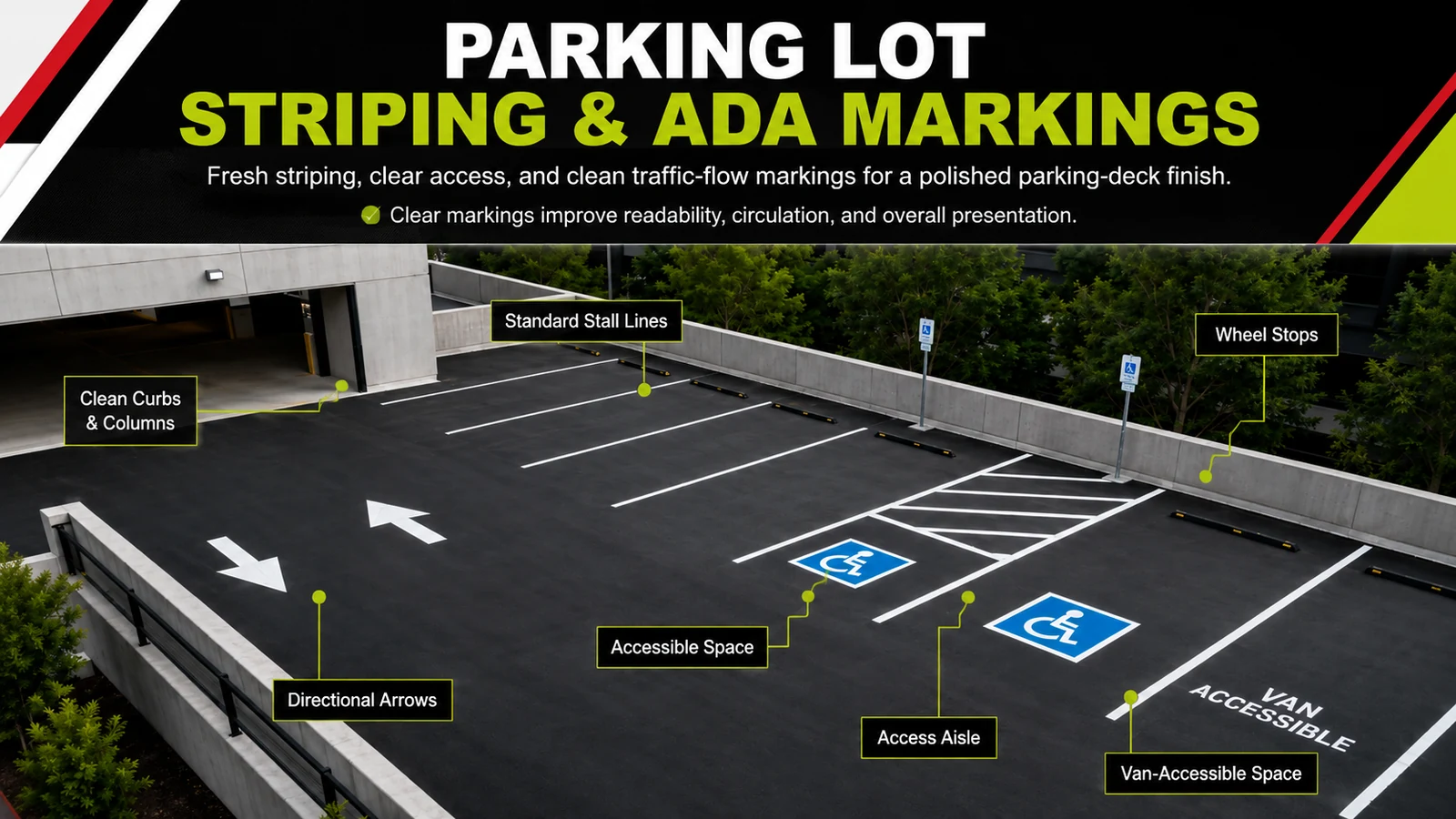
| Striping and ADA layout | Available, and sequenced after the wash rather than before it. See parking lot striping and ADA. |
| Drain lines | We protect and control drains during the work. Clearing a blocked line downstream of the deck is a plumbing scope, not a cleaning one. |
| Lighting and gates | Not a cleaning scope. We report what is broken, because we are on every level of the deck anyway and you should not have to find out later. |
What drives cost
Two decks of the same size can differ by a factor of two. The drivers are predictable enough that we can tell you which one yours is on the walk.
We give you the drivers with the number, so you can see which one is moving your price and decide whether to change it.
Your side of it
The parts of a deck job that go wrong are usually not on our side of the line. They are notice, access and a decision maker.
None of this is difficult, and none of it is unusual. It is listed because the deck jobs that overrun almost always overrun on one of these five, not on the washing.
ADA
The count is set by the total number of spaces in the facility, and it is the single most common thing a restripe gets wrong.
Under the 2010 ADA Standards for Accessible Design, section 208.2, a parking facility with 1 to 25 total spaces requires 1 accessible space, and that one must be van accessible. The requirement scales with the size of the facility, and a deck that has been restriped without checking the table can fall out of compliance without anyone noticing until it is raised as a complaint.
| Total spaces in facility | Accessible spaces required | Of which van accessible |
|---|---|---|
| 1 to 25 | 1 | 1 |
| 26 to 50 | 2 | 1 |
| 51 to 75 | 3 | 1 |
| 76 to 100 | 4 | 1 |
| 101 to 150 | 5 | 1 |
| 151 to 200 | 6 | 1 |
| 201 to 300 | 7 | 2 |
| 301 to 400 | 8 | 2 |
| 401 to 500 | 9 | 2 |
| 501 to 550 | 11 | 2 |
| 551 to 600 | 12 | 2 |
| 601 to 650 | 13 | 3 |
| 651 to 700 | 14 | 3 |
| 701 to 750 | 15 | 3 |
| 751 to 800 | 16 | 3 |
| 801 to 850 | 17 | 3 |
| 851 to 900 | 18 | 3 |
| 901 to 950 | 19 | 4 |
| 951 to 1000 | 20 | 4 |
| 1001 and over | 20 plus 1 per 100 | 1 of every 6 |
Counts are per parking facility. Where a site has several structures, the requirement is applied to each. Above 1000 spaces the count is 20 plus one for each 100 or fraction thereof over 1000, and at least one of every six accessible spaces, or fraction of six, must be van accessible. Source: United States Access Board, ADA Standards chapter 5, section 208.2. Read 2026-08-30.
Straight answers
No, and this is the whole point. We take the deck in sections so only the section being worked has to clear. That is slower than closing the deck, and it is the reason the deck stays usable.
Where a property needs it, yes. Most occupied decks we have run were worked in daytime sections instead, which costs less and disrupts less than people expect. We will tell you which fits your deck on the walk rather than selling you the more expensive one by default.
A four-level occupied deck worked in sections took 4.5 days. A deck that can be closed goes faster. The variables are levels, square footage, oil loading and how much relocation room there is.
Drains are protected before work starts and discharge is directed to where your site permits it. Deck runoff carries oil and heavy solids, so it is treated as a control problem, not an afterthought.
Most decks in this market do well on an annual full wash with a mid-year pass on the drive lanes and entries, which take the most traffic. We will tell you if yours does not need that.
Yes. Washing first and striping after is the correct order, and running them as one mobilization costs less than buying them separately.
Not at the pressures and standoff used for deck slabs. The risk on a deck is not the concrete itself, it is the joints, any coating already down, and anything that was already spalling. Damage on a deck usually means someone found a weak spot rather than made one, which is why the deck gets walked and photographed before a machine runs.
We work around them, photograph the stall and hand you the list. We do not tow and we do not touch a vehicle. The properties that get the cleanest result decide the policy before we mobilize rather than during.
Certificates of insurance are issued to your entity before mobilization rather than after, and additional insured or lender wording is handled at the certificate stage. Coverage detail is provided with the vendor packet rather than published here. Additional insured and lender wording is handled at the certificate stage.
Photographs before and after by level, filed against the invoice, plus anything the wash exposed that you did not know about. A deck report that only contains clean pictures is a report that is hiding something.
Yes, across Georgia, and the travel is priced openly rather than buried in the rate. A deck far enough out to need lodging is worth running as a longer continuous push rather than as repeat mobilizations.
Thrare Contracting performs parking deck and parking area maintenance across metro Atlanta, covering washing and degreasing, stair cores and elevator lobbies, columns and wheel stops, drain and discharge control, and striping with ADA layout. Decks are worked in sections so the facility does not close. A four level occupied deck was completed in 4.5 days with vehicles still on it.
Deck pricing is not square footage times a rate, and any number quoted before a walk is a guess. Six things move it: the number of levels and whether water and equipment reach the top one, how much soaked in oil the drive lanes carry, how much relocation room exists for sectioning, where wash water is permitted to discharge, how much hand work the columns and stair cores need, and whether the schedule allows daytime work rather than nights.
Most decks in metro Atlanta hold well on an annual full wash with a mid year pass over the drive lanes and entries, which take the heaviest traffic. A deck with high turnover, a restaurant or medical tenant, or a history of oil loading may want two full washes. We will tell you if yours does not need the extra pass.
Under the 2010 ADA Standards for Accessible Design, section 208.2, the count scales with the facility total. A facility with 1 to 25 spaces needs 1 accessible space and it must be van accessible; 26 to 50 needs 2; 51 to 75 needs 3; 101 to 150 needs 5; and 201 to 300 needs 7, of which 2 are van accessible. The full table is above.
Yes, and that is how we run occupied decks by default. The deck is taken in sections against a posted notice, cars relocate one section at a time rather than all at once, and each section is handed back before the next begins. It is slower than closing the deck and it is the reason the deck stays usable throughout.
The work
Four levels, worked in sections over 4.5 days, with cars still on the deck.
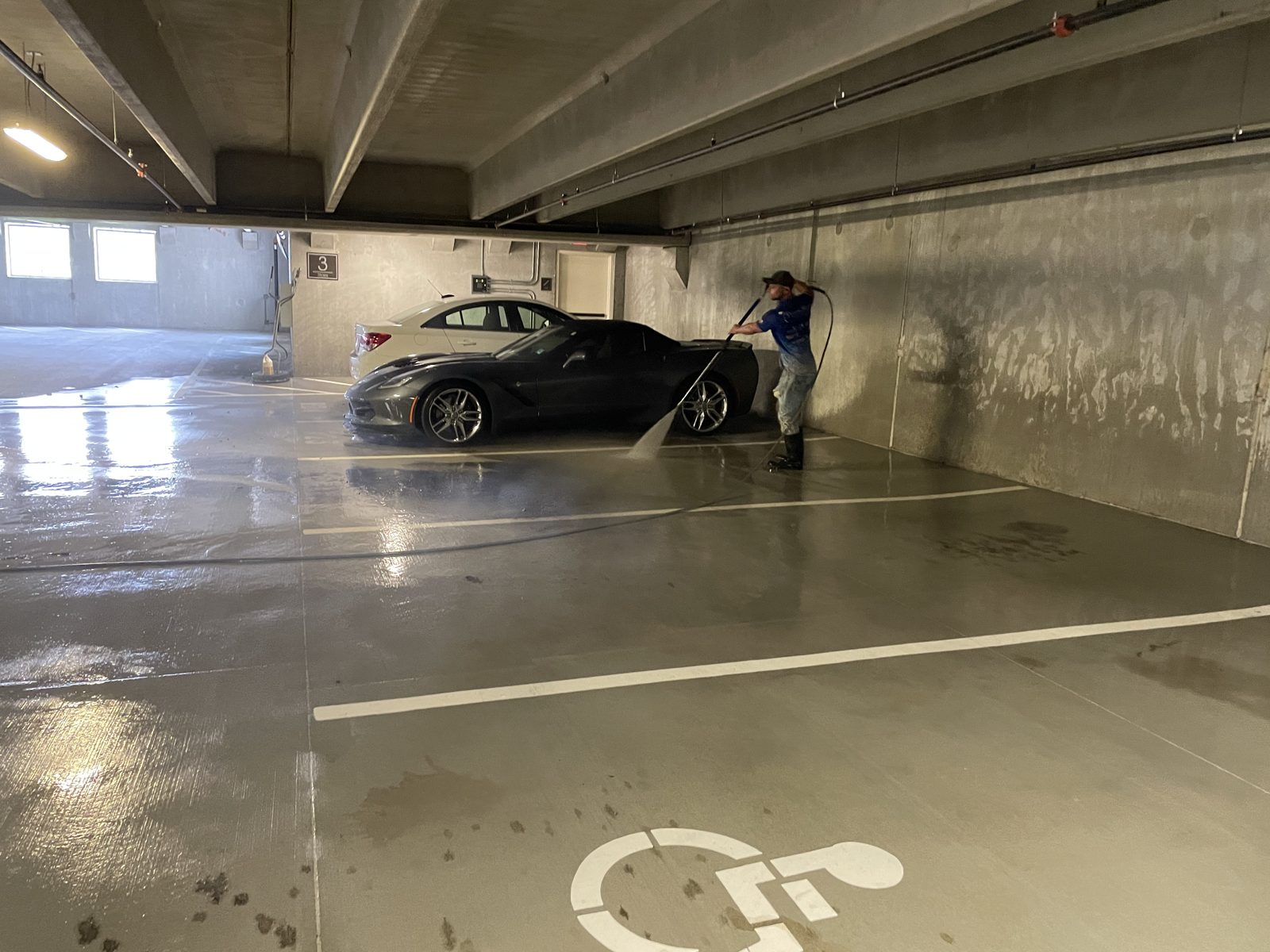
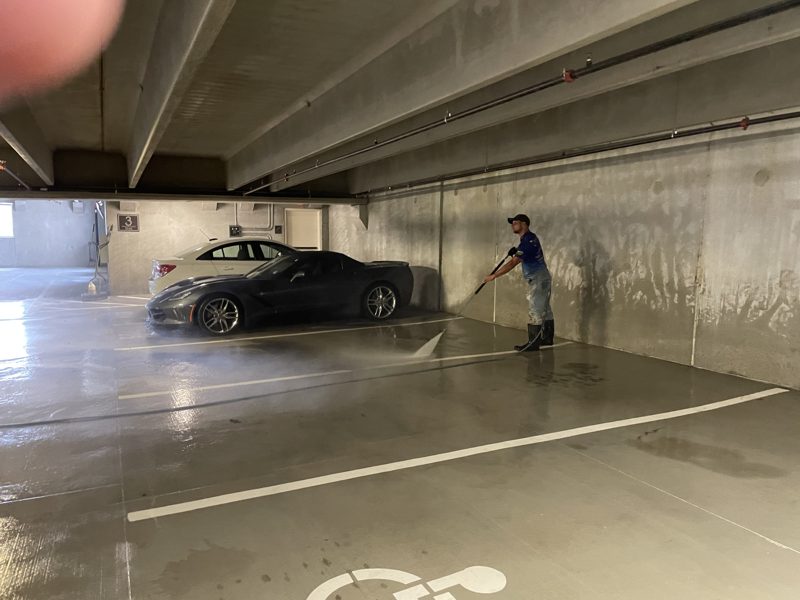
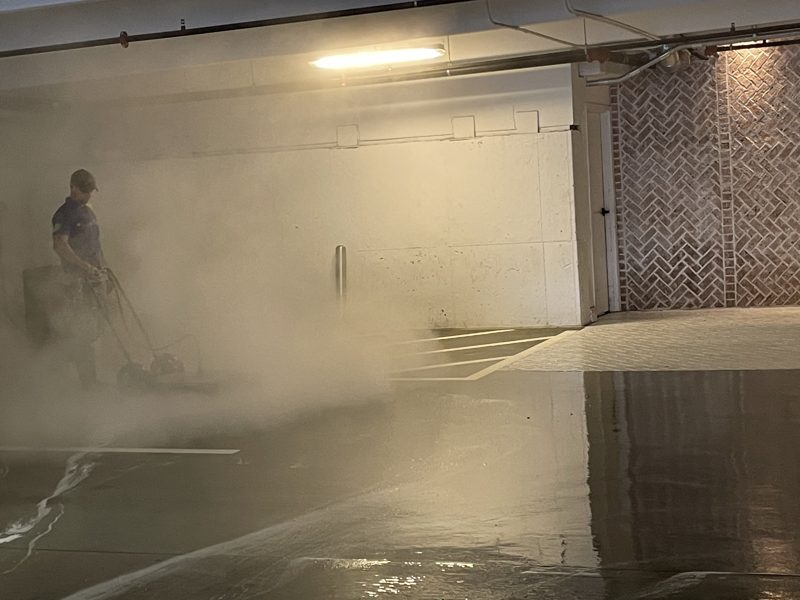
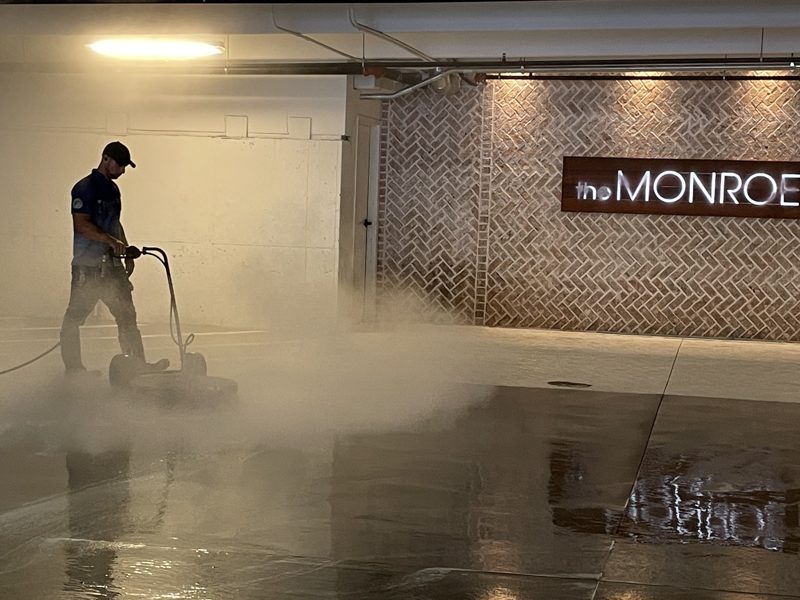
Deck levels during the wash.
Sources
Every checkable claim here names its source, so you can verify it rather than take our word for it.
Accessible parking counts: United States Access Board, ADA Standards chapter 5, Parking Spaces, section 208.2 of the 2010 ADA Standards for Accessible Design. Read 2026-08-30.
Page maintained by Thrare Contracting, a trading name of Rare Earth Ltd, 8735 Dunwoody Pl, Ste R, Atlanta, GA 30350. Certifications and insurance are set out in full on credentials and compliance.
Tell us the property, the scopes, the timing, and the role you need us in. If it fits, we walk the property and come back with a written scope, a schedule and a number, at no cost to you for the walk. If it does not fit, we will tell you that instead of quoting it.
We aim to reply to every submission within one business day, from a person. Prefer to talk first? Call 678-748-3578.