Thrare  ›  Materials, recycling and logistics

Materials in, diverted material out.

On a project with volume, what arrives and what leaves is a cost line and a compliance line at the same time.

Recycled aggregate is crushed concrete, masonry and asphalt processed back into a graded construction material, used as base, subbase and fill in place of quarried stone. Thrare Contracting supplies recycled aggregate and recycled gravel in metro Atlanta and hauls construction and demolition debris in the other direction, with scale tickets and receiving facility receipts kept against every load. Supply and removal run on one schedule, which is what stops material deliveries and debris hauling competing for the same site access.

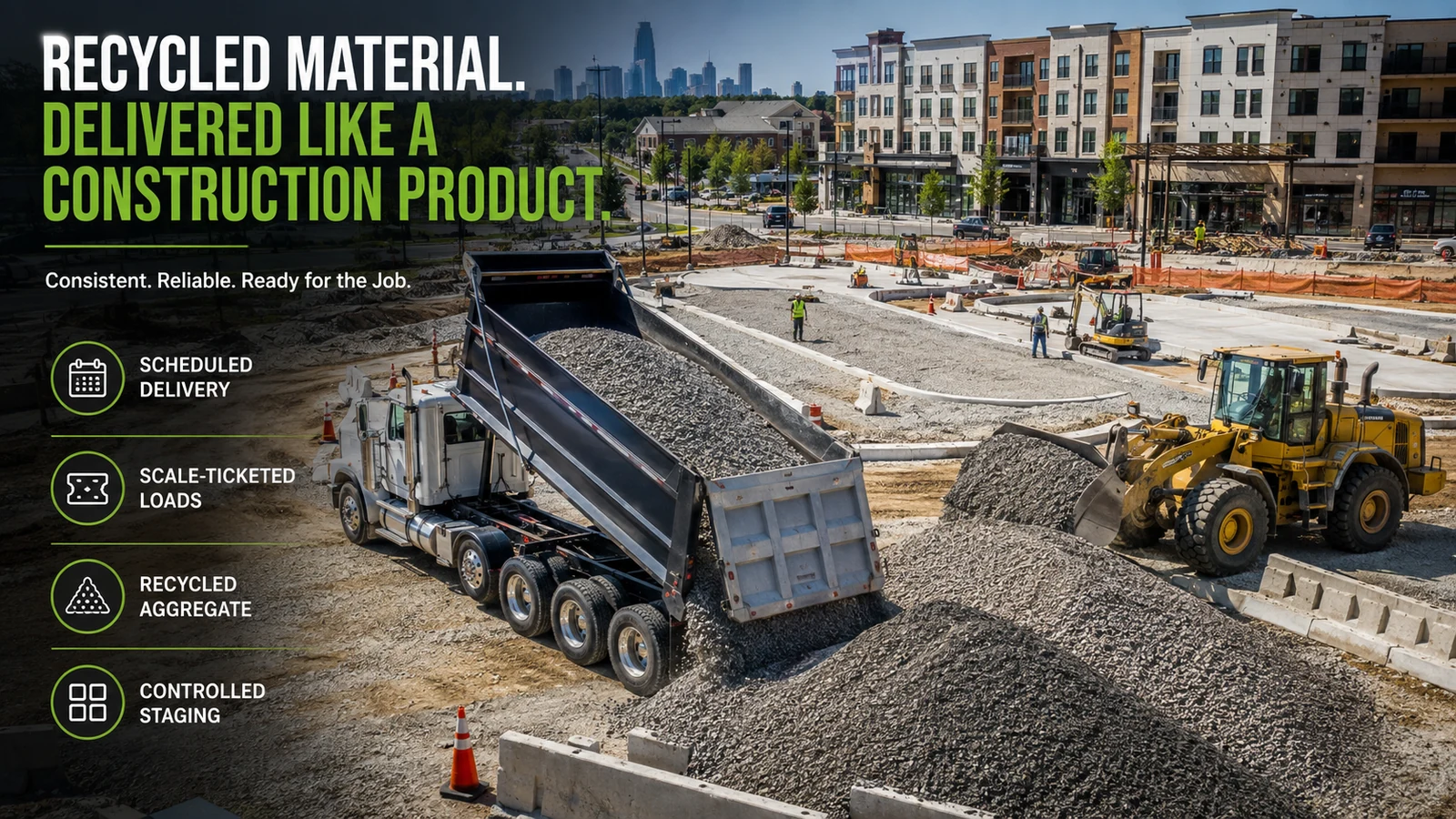
A tandem dump truck discharging recycled aggregate at a mixed use construction site while a wheel loader works the stockpile, labeled scheduled delivery, scale ticketed loads, recycled aggregate and controlled staging
Crushed concrete, masonry and asphalt, processed back into a graded material and delivered on a schedule.

What we supply and move

Two directions, one logistics problem.

Recycled aggregate supply

Crushed concrete and recycled aggregate supplied to public and commercial projects on a delivery schedule.

$198,000+, Fulton County Department of Public Works

Recycling logistics

Separation, staging and haul-off of material that should be diverted rather than landfilled.

More than $50,000, CheckSammy

Debris removal

Construction debris, disaster debris and trash-outs, self-performed, with roll-off coordination.

Site material movement

Staging, load-out and sequencing so material handling does not become the constraint on the trades.

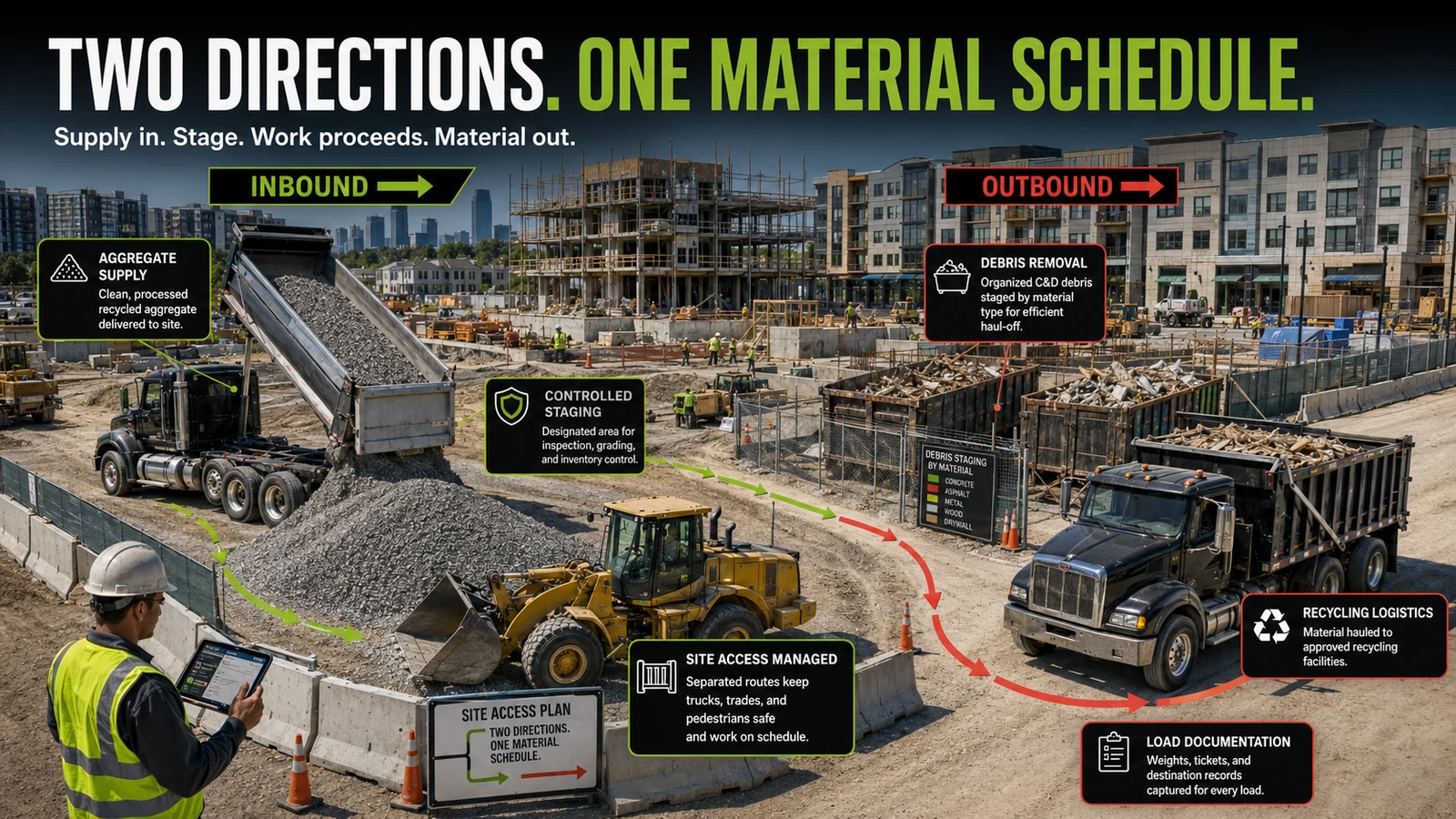
A managed construction site with inbound recycled aggregate delivery and staging on one side and outbound debris removal sorted by material type on the other, with load documentation captured for every truck
Supply in, debris out, on one schedule and one site access plan.

Why it sits under management

Material is a schedule risk before it is a cost.

A trade firm that cannot get material, or cannot get debris away from the work face, stops. That is a coordination failure, not a supply failure.

We self-perform debris and hauling, which means the part of a project most likely to stall the trades is under our direct control rather than another firm’s dispatch queue.

On the supply side, the verified record is more than $198,000 in recycled aggregate supplied to Fulton County Department of Public Works and more than $50,000 in recycling logistics with CheckSammy. Both are recorded in the past performance ledger.

Diversion

What arrives, and what actually leaves.

Diversion is measured on our projects rather than estimated, because it is a cost line and a compliance line at once.

What arrives, and what actually leaves

On a project with volume, the question is not whether material moves. It is how much of it you pay twice for.

Material leaving the siteDiverted and recoveredCrushed, screened, supplied back as aggregateLandfilledWhat genuinely cannot be recoveredDiversion is a cost line and a compliance line at the same time. Both are measured, not estimated.
Diverted and supplied backLandfilled

Inbound

Aggregate is a delivery problem before it is a material problem.

The spec is usually the easy part. What decides whether material helps or hurts your schedule is when it lands, where it can be put, and whether the site can take it.

A load that arrives on the right day into a site with nowhere to stockpile it is not a delivery, it is an obstruction. A load that arrives two days late holds up whatever was going on top of it, and on a paving or base sequence that delay compounds through every trade behind it.

So we plan inbound material against the site, not just against the order. That means agreeing the stockpile location before the first truck rolls, confirming the access route and any weight or height restriction on it, and staging deliveries to the rate the crew can actually place rather than dumping the full quantity because it was one phone call.

Where a site cannot take material, we hold it and release it. That is usually cheaper than the alternative, which is paying a crew to work around a pile in the wrong place for a fortnight.

  1. Confirm the spec and the quantityGradation and quantity against what the work actually calls for. Over ordering is the most common and least visible waste on a material line, because nobody itemises the surplus that got graded into a corner.
  2. Walk the access routeApproach, turning room, overhead restrictions and anything on the route that limits the load. Finding this out with a loaded truck on site is expensive and entirely avoidable.
  3. Agree the stockpile before deliveryWhere it goes, how long it sits, and who is responsible for it while it does.
  4. Stage to the placement rateDeliveries matched to what the crew can place, so material arrives as it is needed rather than all at once.
  5. Ticket every loadScale tickets retained and reconciled against the order, so the quantity billed is the quantity delivered and both of you can prove it.

Outbound

Diverted only counts if you can prove it.

Diversion is easy to claim and hard to evidence, and the difference matters most on exactly the projects where somebody will ask.

Every hauler will tell you that material was recycled. Very few will hand you the paperwork that shows where it went and what it weighed. On a public project, an owner with a diversion target, or any job where the reporting is audited later, that paperwork is the deliverable and the truck is just how it got there.

We keep the trail as the work runs rather than assembling it afterward. Each load leaves with a ticket, the receiving facility is a permitted one, and the receipts are reconciled by stream so the tonnage in the report is the tonnage on the tickets. If a load went to landfill because nothing else would take it, that is what the record says. A diversion report that reads one hundred percent on every stream is a report that was written rather than measured.

This page is the level above the material itself. If you are looking for the product rather than the program, the detail sits on the pages below: recycled aggregates for gradations and typical uses, recycled gravel in Atlanta for local supply, and recycling logistics for the hauling and diversion side on its own. What this page covers is the case for buying them under one schedule instead of three.

Concrete and masonryThe highest value stream and the one most reliably diverted, because there is a real market for crushed material at the other end.
MetalsSeparated on site where the volume justifies it. Worth doing, and worth telling you what it returned rather than absorbing it.
Wood and green wasteDiverted where a receiving facility is in range. Contamination is what kills this stream, so it is separated at the source or not claimed.
Mixed and residualWhat is left after separation. Reported honestly as residual rather than folded into a diversion percentage to improve it.

Scope boundary

What we do not haul.

Some material needs a licensed specialist, and the honest answer at the quote stage is cheaper for you than the discovery on site.

Regulated and hazardous waste is not our scope. That includes asbestos containing material, contaminated soil, chemical and fuel waste, and anything requiring a licensed abatement or hazardous waste transporter. If a demolition or renovation scope has not been surveyed for it, that survey belongs before the hauling is priced, not after a load has already left the site.

We will tell you when we think a scope needs that survey. We would rather lose the hauling line than move something we are not licensed to move, and the exposure on getting that wrong sits with the property as much as with the contractor.

The context

How much construction debris actually becomes aggregate?

More than half of it, which is why recycled aggregate is a real supply chain rather than an environmental gesture.

The United States generated 600 million tons of construction and demolition debris in 2018, more than twice the volume of municipal solid waste, and just over 455 million tons of it was directed to next use rather than landfill. Aggregate was the single largest of those next uses at roughly 313 million tons, about 52 percent of everything generated. Around 144 million tons went to landfill.

Two figures from the same dataset are worth knowing if you are specifying or hauling. Demolition accounts for more than 90 percent of C&D debris generation and construction for less than 10 percent, so the diversion opportunity sits in demolition and renovation rather than in new build. And concrete, asphalt and rubble are the streams with a genuine market at the other end, which is why they divert reliably while mixed loads do not.

US construction and demolition debris, 2018
MeasureVolumeDetail
Generated600 million tonsUnited States, 2018, all C&D debris
To next use455 million tonsDirected away from landfill
As aggregate313 million tonsThe largest single next use
To landfill144 million tonsThe remainder
From demolitionOver 90%Construction is under 10%

Source: United States Environmental Protection Agency, Advancing Sustainable Materials Management 2018 Fact Sheet, via the EPA Sustainable Management of Construction and Demolition Materials and C&D Material-Specific Data pages. Read 2026-08-30.

Straight answers

What buyers ask about material.

Can you supply and haul on the same project?

Yes, and that is usually where this is worth buying as one scope rather than two. The same schedule governs both, so inbound material and outbound debris can be sequenced against each other instead of competing for the same access and the same site room.

What documentation do we get?

Scale tickets for every load, receiving facility receipts, and a reconciliation by stream. On the supply side, tickets reconciled against the order so the quantity billed is the quantity delivered. It is kept as the work runs, which is why it is available at closeout rather than six weeks later.

Do you handle hazardous or regulated material?

No. Asbestos containing material, contaminated soil, chemical and fuel waste and anything needing a licensed abatement or hazardous waste transporter is outside our scope. If a scope has not been surveyed for it, that survey belongs before the hauling is priced.

What if the site cannot take delivery when the material is ready?

We hold it and release it against the placement rate. Paying to store material briefly is almost always cheaper than paying a crew to work around a stockpile in the wrong place, and far cheaper than a delivery that blocks the access route.

Can you work as a subcontractor under our prime?

Yes. Prime, subcontractor or teaming partner are all arrangements we take, and the role is agreed at the fit review rather than assumed. See teaming and joint pursuits.

How far do you deliver?

Across Georgia. Beyond the immediate metro the haul distance becomes the dominant cost on a material line, so it is priced openly and you can see it, rather than being folded into a rate that looks competitive until the quantity moves.

Where can I buy recycled aggregate in Atlanta?

Thrare Contracting supplies recycled aggregate and recycled gravel across metro Atlanta and Georgia, delivered against an agreed stockpile location and staged to the rate your crew can place. Gradations and typical uses are set out on recycled aggregates, and local supply on recycled gravel in Atlanta.

Is recycled aggregate as good as virgin stone?

For base, subbase and fill applications it performs as a graded material and it is the largest single next use for construction debris in the country, at roughly 313 million tons a year. Whether it suits a specific application depends on the specification you are working to, and any project with a written spec should be checked against that spec rather than against a general claim. We will tell you when virgin material is the right answer.

Who hauls construction debris in Atlanta?

We do, across metro Atlanta and Georgia, with scale tickets on every load and receipts from permitted receiving facilities reconciled by stream. Concrete and masonry, metals, and wood and green waste are separated where volume justifies it. What is left is reported as residual rather than folded into a diversion percentage to improve the number.

Can you prove where our debris actually went?

Yes, and that is the deliverable on any project where diversion is audited. Every load leaves with a ticket, the receiving facility is permitted, and receipts are reconciled by stream so the tonnage in the report matches the tonnage on the tickets. If a load went to landfill because nothing would take it, the record says so.

Do you handle asbestos or contaminated soil?

No. Asbestos containing material, contaminated soil, chemical and fuel waste and anything requiring a licensed abatement or hazardous waste transporter is outside our scope. If a demolition or renovation scope has not been surveyed for it, that survey belongs before the hauling is priced rather than after a load has left.

How does concrete recycling and concrete waste processing actually work?

Crushing, screening and grading demolition concrete back into a usable aggregate, with steel separated out magnetically during processing. The full process explainer, including what concrete reprocessing produces at each stage, is on our concrete recycling process guide. This page is about buying the output and moving the input, rather than the process itself.

Do you supply recycled aggregate for large commercial or public projects?

Yes. The recorded supply engagement on this page is a county public works contract running March 2025 to March 2026, delivered as prime alongside Metro Green Recycling and Martin Marietta. Deliveries are staged to placement rate against an agreed stockpile, and scale tickets are reconciled against the order so billed quantity matches delivered quantity.
Sources

Where the figures on this page come from.

Every national figure quoted here is EPA data with a link, so you can check it rather than take our word for it.

Construction and demolition debris volumes and next use: United States Environmental Protection Agency, Sustainable Management of Construction and Demolition Materials and Construction and Demolition Debris: Material-Specific Data, drawn from the Advancing Sustainable Materials Management 2018 Fact Sheet. Read 2026-08-30.

Page maintained by Thrare Contracting, a trading name of Rare Earth Ltd, 8735 Dunwoody Pl, Ste R (#6), Atlanta, GA 30350. Certifications and insurance are set out in full on credentials and compliance.

UpstreamManaged capital projectsRelatedCommercial property programsEvidencePast performanceCoverageWhere we work in metro Atlanta

Request a project fit review.

Tell us the property, the scopes, the timing, and the role you need us in. If it fits, we walk the property and come back with a written scope, a schedule and a number, at no cost to you for the walk. If it does not fit, we will tell you that instead of quoting it.

PDF, Word, Excel, image or ZIP, up to 8 MB. Submitted documents are used only to scope your project. They pass through our website form processor in transit and are not published or sold. If the upload fails, send the file to [email protected] with your company name.

We aim to reply to every submission within one business day, from a person. Prefer to talk first? Call 678-748-3578.