The record
Photographed by level.
Before and after by level, filed with the invoice. These are frames from the job described above.
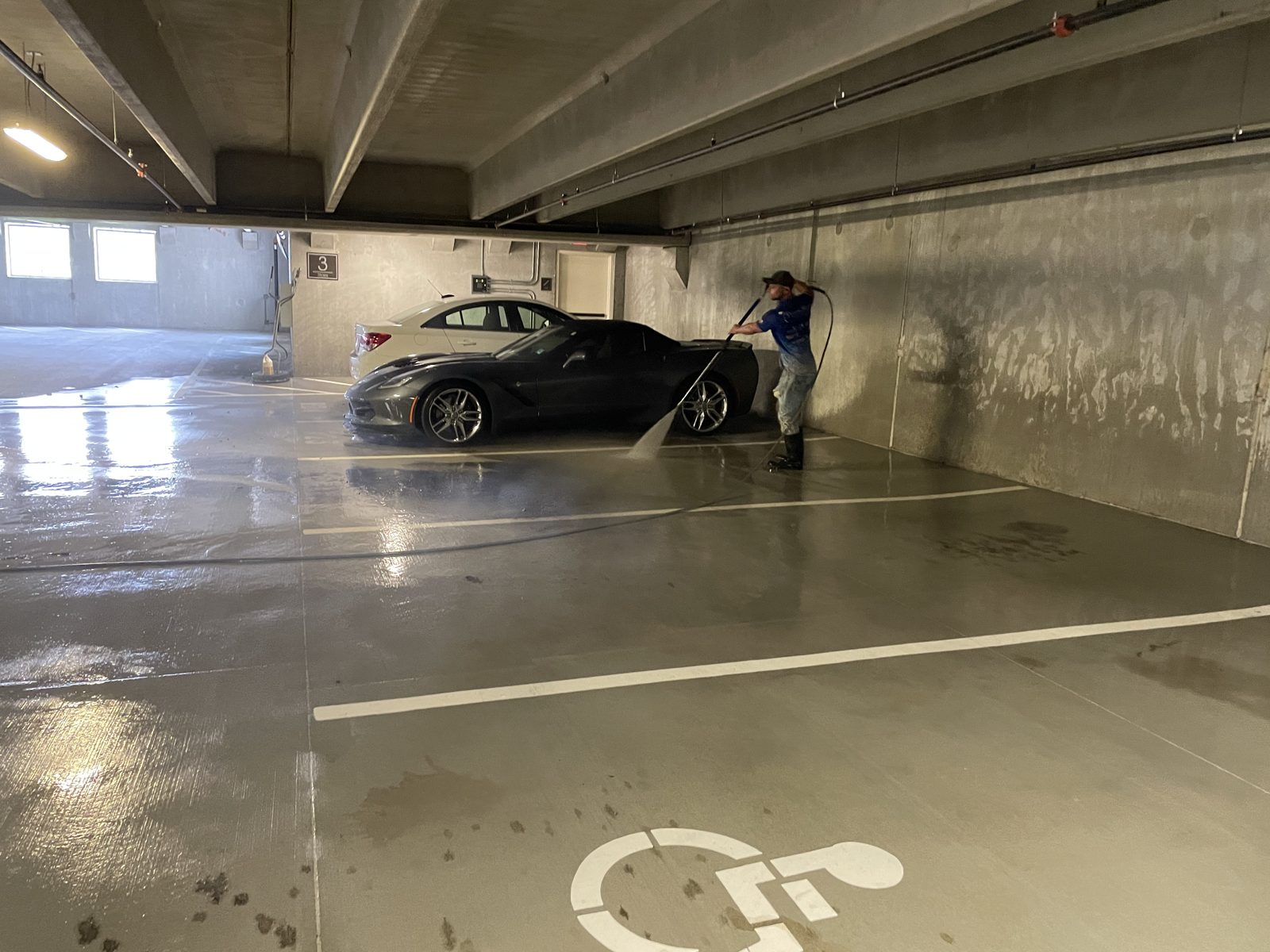
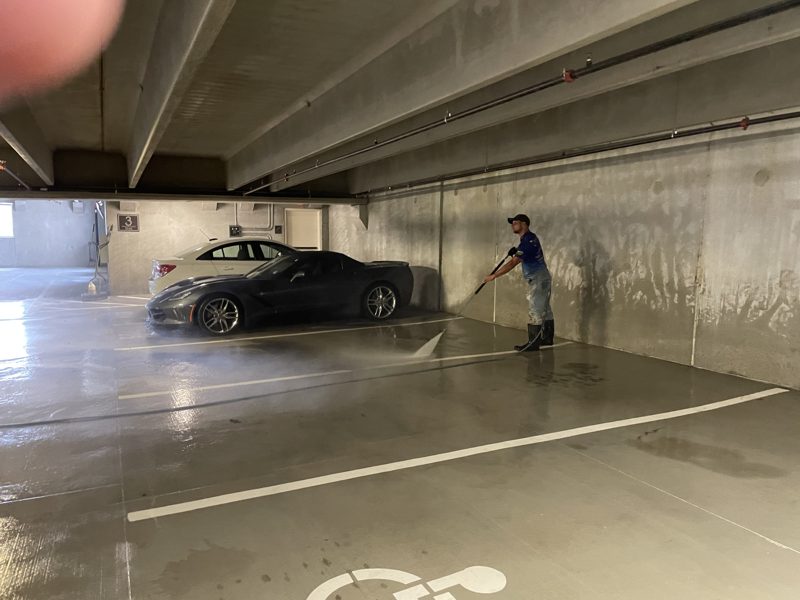
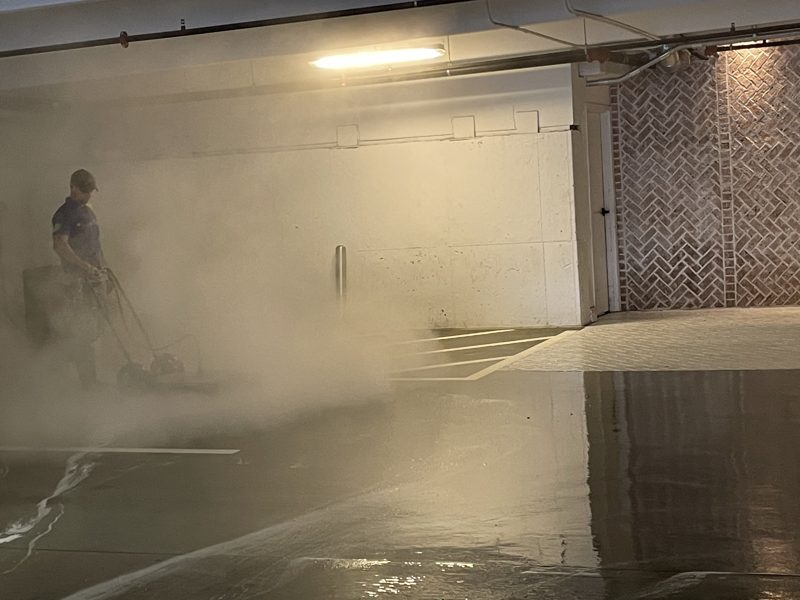
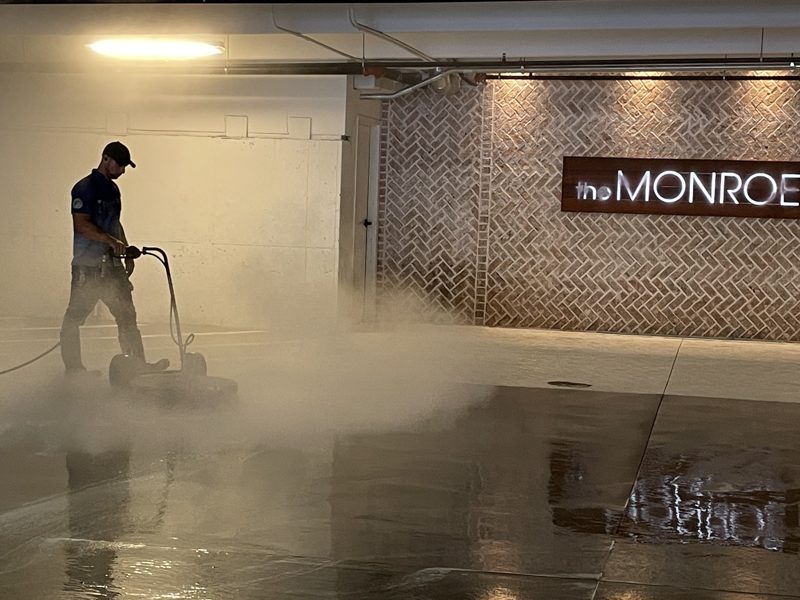
Levels of the same deck during the work.
Thrare › Case: a four level deck, in sections
The property could not close the deck. That single constraint set the method, the sequence and the pace.
The property
A four level structured parking deck serving an occupied apartment community. Resident parking on every level, a single vehicle route through the structure, and stair cores and lobbies carrying the same foot traffic as the slab.
The deck had the condition profile that every occupied deck develops. Oil concentrated in the drive lanes and at the stalls where vehicles sit longest. General soil across the slab, heaviest at the entry and exit where tires carry it in. Columns and curbs holding the visible grime that makes a clean floor still read as dirty.
The constraint was not the surface. It was that residents had to keep parking there the entire time, on a property where people leave for work on a schedule nobody was going to change for a cleaning contractor.
The constraints
Four separate limits shaped the plan before any equipment was specified.
No closure available at any point. Residents needed parking every night and access every day.
Cars could be relocated a section at a time, never all at once, and only against notice residents actually received.
Deck drains discharge to a system that was never intended to receive oil and heavy solids from a wash.
Working in sections is slower than working an empty deck. The schedule had to absorb that rather than fight it.
What we did
The plan was built around handing space back rather than around covering ground quickly.
The outcome
The result a manager can verify is the simplest one: nobody had to be told where to park.
All four levels were degreased and washed across 4.5 days on site. The slab, drive lanes and stalls came back to a uniform surface, and the vertical elements were cleaned on the same pass so the deck did not read as half finished. Wash water and solids were controlled rather than sent to the drain untreated.
The deck stayed in service every day of the work. The photographic record went to the manager with the invoice, which is what turns a completed job into something that can be approved without an argument or a site visit.
Straight answers
Because most properties cannot. A closure means finding parking for every resident for the duration, and on this property that was not available. Working in sections costs more days and no goodwill.
Not materially on this deck, and it costs more. Overnight is the right answer where a property has daytime constraints that sections cannot solve, and we will say so when that is the case.
Applied correctly, no. The risk on a deck is not aggression on the surface, it is uncontrolled discharge and standing water in the low spots.
It depends on levels, square footage, oil loading and how much relocation room there is. The walk is free and the number comes back in writing.
The record
Before and after by level, filed with the invoice. These are frames from the job described above.
Levels of the same deck during the work.
Drainage
Containment is the part of deck work that decides whether the job was done properly, and it is invisible in the after photographs.
Wash water from a deck carries everything the slab has been holding: oil and grease from drive lanes and stalls, brake dust, sediment, and whatever degreaser was used to lift it. Under the Clean Water Act and the NPDES stormwater regulations at 40 CFR Part 122.26, that is a non-stormwater discharge and it must not enter a municipal separate storm sewer system unless authorized by an NPDES permit. Most deck drains run to that system with nothing in between.
The compliance path is containment rather than paperwork. If nothing reaches the storm system, there is nothing to authorize. On a deck that means identifying where each level actually drains before the first section is washed, blocking or bunding those points inside the work zone, recovering the water, and disposing of it according to what it is carrying.
Where the water goes is decided at the walk, not on the day. A deck whose drainage has been modified since it was built, or where a level discharges somewhere the drawings do not show, is common enough that assuming the drawing is a way to produce an illicit discharge with good intentions.
Accessibility
Cleaning and striping are usually bought together on a deck, and the striping half is where the compliance exposure sits.
Section 208.2 of the ADA Standards sets the minimum accessible spaces by facility size: 1 to 25 spaces requires 1 accessible space and it must be van accessible; 26 to 50 requires 2; 501 to 1000 requires 2 percent of the total; and above 1000 it is 20 plus 1 for each 100 or fraction over 1000. At least 1 of every 6 accessible spaces must be van sized, and each needs an access aisle at least 60 inches wide and as long as the space.
On a structured deck two things complicate that. Van accessible spaces need vertical clearance on the route to them, so they cannot simply be assigned to whichever level has spare width. And decks are frequently restriped by matching the existing layout, which carries any historic shortfall forward with a fresh date on it.
We measure before marking. Where a count or an aisle width does not meet the standard, that is raised before paint goes down rather than discovered afterward, because removing paint from a deck slab means grinding and a visible ghost.
Price
Deck pricing is not square footage times a rate, and a quote that looks like it is has left something out.
In the number: mobilization, labor and equipment, water supply, degreaser and chemical, containment and water recovery, the section-by-section notice and vehicle relocation plan, and cleanup of our own work area. Night or early-morning sequencing is priced in where the property needs it, at quote rather than at scheduling.
Not in the number: repairs to a slab that is already spalling or delaminating, sealing or coating, remediation of a spill we did not cause, and remobilization caused by a level that could not be cleared at the confirmed time. Where the deck has a stormwater condition specific to the property, working to it is included once we have been sent it.
Cleaning does not fix a slab that has failed. Spalled concrete and exposed rebar come out cleaner and still look bad, because the problem was never dirt. That gets said at the walk rather than after the invoice.
Sources
Both rules referenced above are quoted from the regulator so you can check them rather than take our word for it.
Wash water discharge: United States Environmental Protection Agency, NPDES Stormwater Program, and 40 CFR Part 122.26. Wash water from exterior cleaning is a non-stormwater discharge and must not enter a municipal separate storm sewer system unless authorized by an NPDES permit. Read 2026-08-31.
Accessible parking counts, van ratio and access aisle width: United States Access Board, ADA Standards for Accessible Design, chapter 5, Parking Spaces, section 208.2 of the 2010 Standards. Read 2026-08-31.
Page maintained by Thrare Contracting, Rare Earth Ltd, 8735 Dunwoody Pl, Ste R, Atlanta, GA 30350.
From the property
Every item here exists because its absence turns a sequenced job into a closure.
A notice route that actually reaches residents, and the lead time your community requires for it. Posted signage on the deck alone is not notice, it is a reminder for people who already knew. Where relocation is needed, somewhere for those vehicles to go: a section held empty, a neighboring lot, or a level taken out of rotation ahead of the work.
Confirmation of where each level drains, and any modification made since the deck was built. Drawings are a starting point and not an authority on a structure that has been altered. Clearance heights for our equipment on every level we are expected to work, because a machine that fits on level two and not on level three changes the whole sequence.
Water and power sources, or confirmation that we bring our own. A named contact who can authorize a change on the day, since a deck sequence that stalls waiting for a decision leaves a section closed longer than anyone was told, which is the one outcome the whole plan exists to avoid.
Why sections
Taking a deck level by level sounds tidier and produces the worst outcome available.
A level is a large unit of closure. Closing one displaces every vehicle on it at once, which means the relocation has to succeed completely before any work starts and the level stays shut until the whole floor is finished and dry. If anything slows down, the entire level stays closed, and residents experience that as an outage rather than as maintenance.
A section is small enough that relocation is absorbed by the deck itself. Vehicles move a section at a time into space that has already been released, each piece is handed back before the next one opens, and the deck never has more than one small area unavailable. A resident should never have to ask where to park.
The trade is duration: sectioning takes longer in total than closing floors would. That is the correct trade on an occupied residential deck, where the cost of a closure is measured in complaints and in the management time spent answering them rather than in labor hours.
Containment is planned per section rather than per deck, which is the other reason the sequence is built this way. Each section is bunded and recovered before the next one opens, so there is never a live wash area draining toward a section that has already been handed back.
Tell us the property, the scopes, the timing, and the role you need us in. If it fits, we walk the property and come back with a written scope, a schedule and a number, at no cost to you for the walk. If it does not fit, we will tell you that instead of quoting it.
We aim to reply to every submission within one business day, from a person. Prefer to talk first? Call 678-748-3578.