Metro Atlanta · Residential & Commercial

The substrate sets the pressure. The address sets the rule.

Thrare Contracting pressure washes houses, driveways, roofs, pool decks and commercial exteriors across metro Atlanta. Two questions decide every job before a machine starts: which stormwater ordinance governs the property, and what pressure the cladding manufacturer publishes for that surface.

Wash water contained on site Manufacturer pressure limits, cited Residential and commercial DBE, MBE and SAM registered
Who This Is For

Who does Thrare Contracting pressure wash for in metro Atlanta?

Thrare Contracting pressure washes for four buyers in metro Atlanta, and each one buys a different thing.

Thrare Contracting keeps the metro Atlanta hub material on this page for all four buyers. A city page carries the rule for one address. The hub carries what every address in the metro shares: which government's ordinance governs a given property, what each cladding manufacturer publishes as a pressure ceiling, how the work is sequenced, and what a scope includes before anyone puts a number on it.

The Constraint

What constraint is a metro Atlanta property owner actually under?

A metro Atlanta property owner is under a discharge constraint, not a cosmetic one.

Wash water from exterior cleaning is a non-stormwater discharge. The federal definition is not vague about it: 40 CFR 122.26(b)(2) defines an illicit discharge as "any discharge to a municipal separate storm sewer that is not composed entirely of storm water except discharges pursuant to a NPDES permit (other than the NPDES permit for discharges from the municipal separate storm sewer) and discharges resulting from fire fighting activities." Soap, algaecide, roof granules, tire rubber, oil and clay are none of them storm water.

The Environmental Protection Agency's NPDES stormwater program regulates discharges from municipal separate storm sewer systems, construction activities and industrial activities, and in Georgia the program is administered by the Environmental Protection Division's Watershed Protection Branch. A permit is the wrong tool for a wash crew. Containment is the right one: if nothing reaches a storm drain or a surface water, there is no discharge to authorize and the permit question never opens.

The second constraint is the surface. Four different bodies publish four different pressure ceilings for four different claddings, and the numbers are not close to each other. A crew that carries one setting from a driveway to a brick wall to a fiber cement elevation will damage two of the three. Both constraints are answered below, with the source named.

Jurisdiction

Which government's stormwater rule applies to a given metro Atlanta address?

The city's ordinance applies at an incorporated address, and the county's applies only where the county is the one that owns the pipe.

Metro Atlanta is a patchwork of municipal separate storm sewer systems, and each ordinance scopes itself to the system its own government owns or maintains. Handing a Marietta board a Cobb County document, or an Atlanta board a Fulton County document, cites an authority that does not reach the property. The table below records what each code says about its own reach.

If the property sits inThe governing instrumentWhat that instrument scopes itself to, in its own words
City of Atlanta limitsAtlanta City Code, Chapter 74, Article IX, Illicit Discharge and Illegal Connections, sections 74-428 to 74-437"The provisions of this article shall apply throughout the corporate limits of the City of Atlanta" (74-429)
Unincorporated Fulton CountyFulton County Government, Stormwater Services"The purpose of the Stormwater Management Program is to manage the surface water resources of unincorporated Fulton County ... For all other areas of the County, stormwater management is the responsibility of the individual cities"
City of Sandy Springs limitsThe Metropolitan North Georgia Water Planning District Model Illicit Discharge and Illegal Connection Ordinance, adopted by the City and carried at Municode Division 9.8City MS4 under NPDES Phase II permit GAG610000; the City's 2024 Stormwater Management Program records 636 MS4 outfalls and a screening rate of roughly 20% per year
City of Roswell limitsCity of Roswell, Environmental Public Works, Stormwater Utility, whose listed measures include "Illicit discharge detection and elimination"A city stormwater utility funded since 2011 by a fee "based on the amount of impervious surface area on each developed property in the City"
City of Marietta limitsCity of Marietta Code of Ordinances, Article 7-8-18, sections 7-8-18-020 and 7-8-18-030An MS4 "(a) Owned or maintained by the city; (b) Not a combined sewer; and (c) Not part of a publicly owned treatment works"
Unincorporated Cobb CountyOfficial Code of Cobb County, Chapter 50, Article V, sections 50-181 and 50-191A system "Owned or maintained by unincorporated Cobb County"

Two of those rows are the ones that get misquoted. Fulton County states in its own words that its program covers unincorporated Fulton and that every other area is the city's responsibility, so a Fulton County stormwater document is the wrong instrument at an Atlanta, Sandy Springs, Roswell, Alpharetta or Milton address. Cobb County's code scopes its system to unincorporated Cobb County, so Cobb County Water's pressure washer guidance is county practice for an unincorporated address and not the rule at a Marietta, Smyrna, Kennesaw, Austell, Acworth or Powder Springs property. The practical instruction to the crew does not change between those rows. Only the authority behind it does.

Above all of them sits a planning body rather than a permitting one. According to the Metropolitan North Georgia Water Planning District, the District "collaborates with 97 cities and 15 counties to conserve and protect our region's vital yet limited water resources", was "Established by the Georgia legislature in 2001 and staffed by the Atlanta Regional Commission", and "Over 100 different jurisdictions fulfill the Resources Management Plan requirements which are enforced by the Georgia Environmental Protection Division." The District issues nothing to a contractor. The District is why so many metro cities run near-identical illicit discharge ordinances, which is the reason the practical answer is stable even where the citation is not.

For an address outside the six rows above, Thrare Contracting confirms the governing ordinance before mobilizing rather than quoting the nearest county document. Where a city page exists, the citation for that city lives there.

City of Atlanta

What does the City of Atlanta ordinance actually say about wash water?

Atlanta City Code section 74-436 prohibits the discharge outright, in one sentence, and names no exemption that reaches exterior rinse water.

Section 74-436 reads: "No person shall throw, drain, or otherwise discharge, cause, or allow others under its control to throw, drain, or otherwise discharge into the storm sewer system of the City of Atlanta any pollutants or waters containing any pollutants, other than stormwater." Section 74-428 then defines an illicit discharge as "any direct or indirect non-stormwater discharge to the storm sewer system of the city, except as exempted in section 74-437 of this article." The article as codified runs from Ordinance No. 2003-75 and is current through Ordinance No. 2026-30, enacted July 15, 2026, at Supplement No. 107.

The definition of a pollutant is where an exterior cleaning scope lands. Section 74-428 lists, among others, "paints, varnishes, and solvents; petroleum hydrocarbons; automotive fluids; cooking grease; detergents (biodegradable or otherwise); degreasers; cleaning chemicals; non-hazardous liquid and solid wastes and yard wastes; refuse, rubbish, garbage, litter, or other discarded or abandoned objects and accumulations". A soft wash mix is a detergent. A degreased dumpster pad produces cooking grease. Leaf litter swept off a roof is yard waste. All three are named.

Wash water is also named directly in the illegal connection definition, which covers any conveyance that allows "any non-stormwater discharge including sewage, process wastewater, and wash water to enter the storm drain system, regardless of whether such pipe, open channel, drain or conveyance has been previously allowed, permitted, or approved by the department of watershed management".

Section 74-437 carries the exemptions, and reading the list is the fastest way to see the answer. Exempt discharges are potable water line flushing by a government agency, other potable water sources, landscape irrigation or lawn watering, diverted stream flows, rising ground water, ground water infiltration to storm drains, uncontaminated pumped ground water, foundation and footing drains, crawl space pumps, air conditioning condensation, springs, natural riparian habitat and wetland flows, any other water source not containing pollutants, firefighting and fire hydrant flushing, other discharges necessary to protect public health and safety, and any non-stormwater discharge permitted under an NPDES permit with written approval. Exterior rinse water appears nowhere in that list.

Enforcement sits with the police and with the commissioner of the Department of Watershed Management or a designee under section 74-431. On the operational side, the City of Atlanta Department of Watershed Management states that the City's Stormwater Management Program "has been developed to work toward elimination of illicit discharges and reduction of pollutants entering the Chattahoochee and Ocmulgee River Basins through the City's stormwater infrastructure", and that the City runs an Illicit Discharge Detection and Elimination program that "investigates the source of water quality complaints reported to Department of Watershed Management". Atlanta straddles a drainage divide, which is a genuinely local fact: two catch basins on one Atlanta property can send water to two different rivers.

Thrare Contracting publishes no penalty figure on this page. The commonly repeated per-day number circulating in the pressure washing trade traces to secondary blogs rather than to the statute, Clean Water Act civil penalties are statutory and inflation-adjusted, and the amount depends on the enforcement route. The rule is the citable part. The scare number is not.
Liability

Who carries the liability when wash water reaches a storm drain?

Atlanta's prohibition reaches the party who discharges and the party who allows the discharge, so hiring a crew does not move the exposure off the property.

The operative words in section 74-436 are "cause, or allow others under its control to throw, drain, or otherwise discharge". A contractor who sends wash water into a catch basin is inside the prohibition. So is the owner or manager who directed the work and controlled the site. A low bid that omitted water handling has therefore not removed the exposure from the property. The bid moved the exposure back to the party who signed it.

Trade bodies say the same thing in their own literature rather than leaving it to regulators. The Brick Industry Association's Technical Notes 20 instructs cleaners to "Control and/or treat runoff in accordance with the requirements of the jurisdiction", and adds that "Some jurisdictions may require containment and treatment of the runoff water before it can leave the site. Dilution of runoff and its release into the stormwater management system should not be expected or allowed unless expressly permitted by the applicable jurisdiction." Sto Corp. and Sika both close their EIFS cleaning bulletins with the same instruction to check local requirements for disposal of wash water and cleaning solutions.

What containment looks like on a Thrare Contracting job

What We Clean

What surfaces does Thrare Contracting clean, and by which method?

Method follows substrate, and the two methods are not interchangeable: soft washing carries the chemistry at low pressure, and high pressure carries the mechanical work on hard flatwork.

House and building washing

Low pressure soft wash with dwell time, which is the correct method for vinyl, fiber cement, brick, stucco, EIFS, cedar and painted surfaces. High pressure on an elevation removes the growth and the finish in the same pass.

Driveways, walks and flatwork

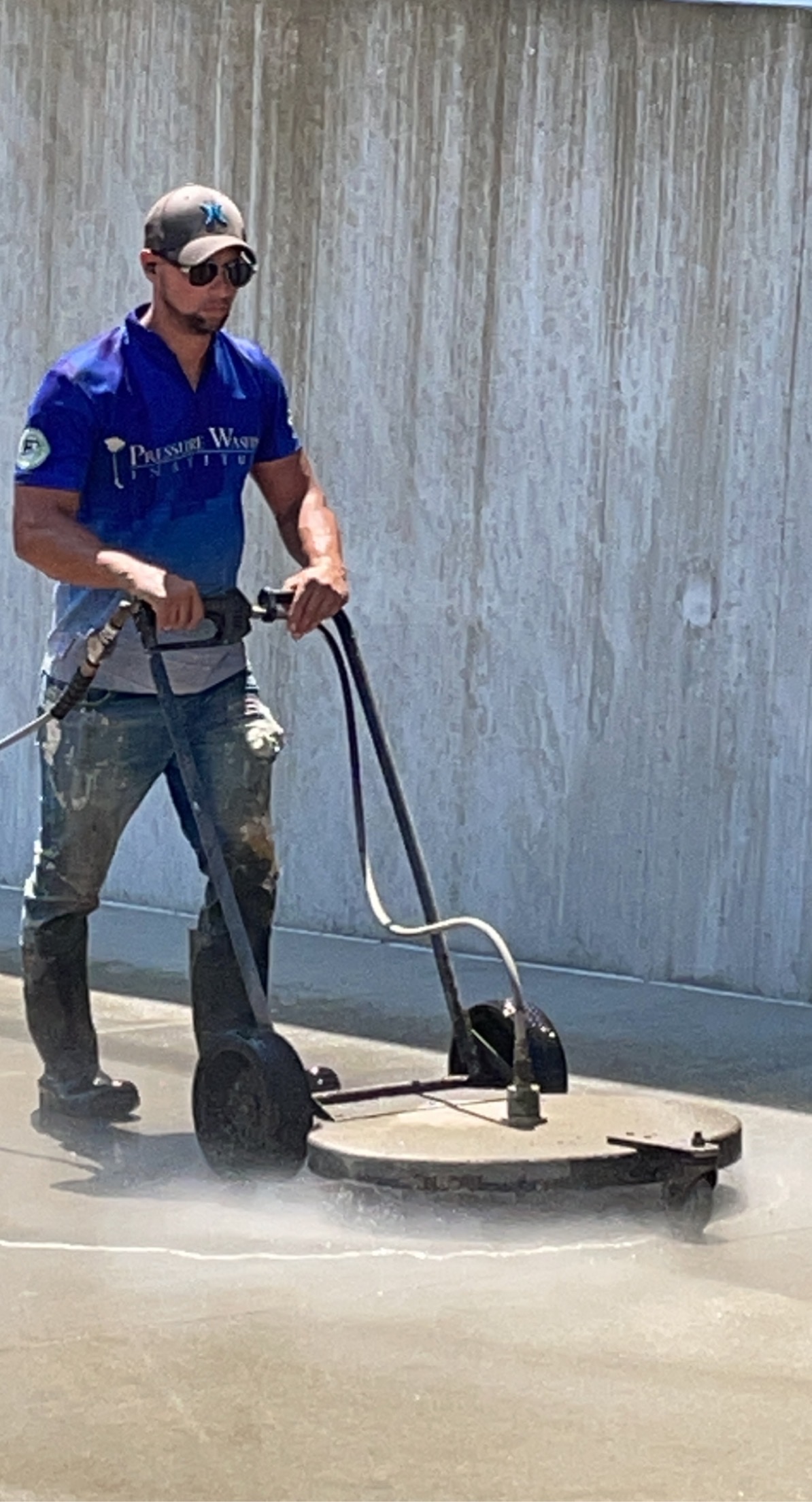
Rotating surface cleaner rather than a wand, which is what makes a large slab come out evenly. A wand on flatwork leaves stripes that stay visible for years in low sun.

Roof soft washing

The black streaking on an Atlanta asphalt roof is cyanobacteria growing in the shingle, and pressure is the wrong tool for it. Soft wash chemistry kills the growth without moving granules.

Pool decks and patios

Broom finish concrete, travertine, flagstone and pavers each take a different approach. Paver work is the one with a published trade specification, quoted in the pressure table below.

Commercial exteriors

Storefronts, drive lanes, dumpster pads, breezeways and parking areas, scheduled around occupancy. The commercial method detail lives on the commercial pressure washing page.

Decks, fences and wood

Mold and mildew removal from wood and composite at pressures that do not raise the grain, including prep for a stain or a sealer applied by others or by us on a separate scope.

Pressure Limits

What water pressure is safe on each exterior substrate?

No single safe pressure exists, because the manufacturers and trade bodies that publish limits publish different ones for different claddings, and the spread runs from 400 psi to 4,000 psi.

SubstratePublished limit, as the document states itWho publishes it
Brick and mortar"Do not use water pressures higher than 400 psi (2800 kPa) as measured at the nozzle tip unless permitted by brick manufacturer". "High-pressure water cleaning is not appropriate for brick and may damage the brickwork." Nozzle: "Use a stainless steel 25 to 50 deg. fan tip, held a minimum of 12 in. (305 mm) from the brick surface". Trial cleaning on a 20 sq ft sample area first.Brick Industry Association, Technical Notes on Brick Construction 20, "Cleaning Brickwork", August 2018
Fiber cement siding"Using wide fan tips that are kept a minimum of 6 feet from the wall and at pressures under 1500 psi will minimize the chance of damaging the siding." Sand blasting and acid washing are both listed as not recommended, and damage from improper cleaning "may not be covered by the James Hardie warranty".James Hardie Building Products, Technical Bulletin 20, November 2018
EIFS and synthetic stucco"If a pressure washer is used, keep the pressure at approximately 200-500 psi ... Do not exceed 500 psi ... pressure, as the EIFS surface integrity can be destroyed with higher pressure washing." No steam cleaning: the EPS insulation board has "a service temperature limit of about 165 deg F (74 deg C)". No solvent based cleaners.Sto Corp., "StoTherm EIFS Reference Guide: Repair and Maintenance", document S707B
EIFS and stucco finishes"Never use water pressure more than 500 psi or allow pressure nozzles to come within 2 feet of the wall." Fan type tips of "30-45 deg. or greater". "The chemicals provide the cleaning, not the water pressure."Sika Corporation, Senergy Technical Bulletin, "Procedure for Cleaning Finish & Removing Efflorescence in EIFS and Stucco", revised February 2024
Interlocking concrete pavers"A high pressure sprayer applies cleaner and water between 1,000 and 4,000 psi (6.9 and 27.6 MPa), and at a rate between 2 and 6 gallons/minute". Efflorescence cleaners go on at "a low pressure pump spray 30 to 100 psi". A wide nozzle at a low angle of attack "prevents sand from being washed from the joints".Concrete Masonry and Hardscapes Association, PAV-TEC-005-22

Three qualifications belong with that table, and leaving them off would misrepresent every source in it. First, each figure is published for the material in its own row. According to the Brick Industry Association, 400 psi at the nozzle tip is a limit for brick, and carrying that number onto fiber cement or a paver drive would be wrong in both directions. Second, James Hardie and Sto and Sika are manufacturers writing about their own products, not standards bodies writing about a material class, so a building clad in a different manufacturer's system needs that manufacturer's bulletin. Third, the Concrete Masonry and Hardscapes Association figures are stated for interlocking concrete pavers and are not a statement about what any given slab of poured concrete will tolerate.

One provenance note, because a buyer who goes looking will hit the same wall. The James Hardie technical bulletin did not serve from the manufacturer's own document hosts on the read date, and the copy actually read was the identical document in Home Depot's product-document library. The Sources block links what was read.

The practical consequence on a quote is small and worth stating. Identifying the cladding is part of the walk, not part of the wash, and a mixed elevation of brick below and fiber cement above is two settings on one wall.

Real Results

What does a single visit actually change?

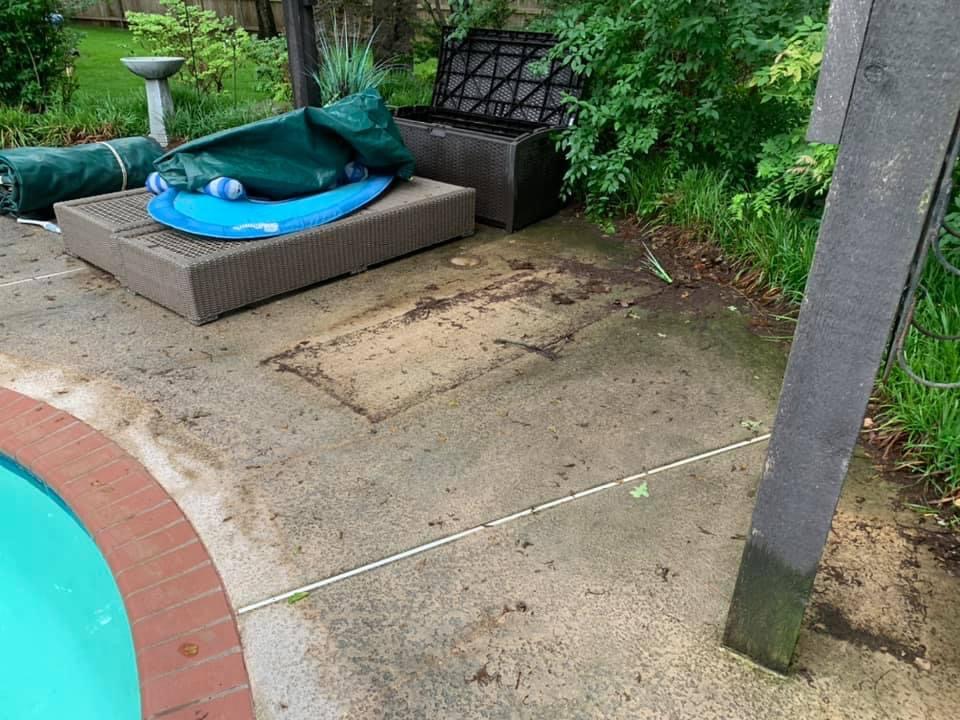
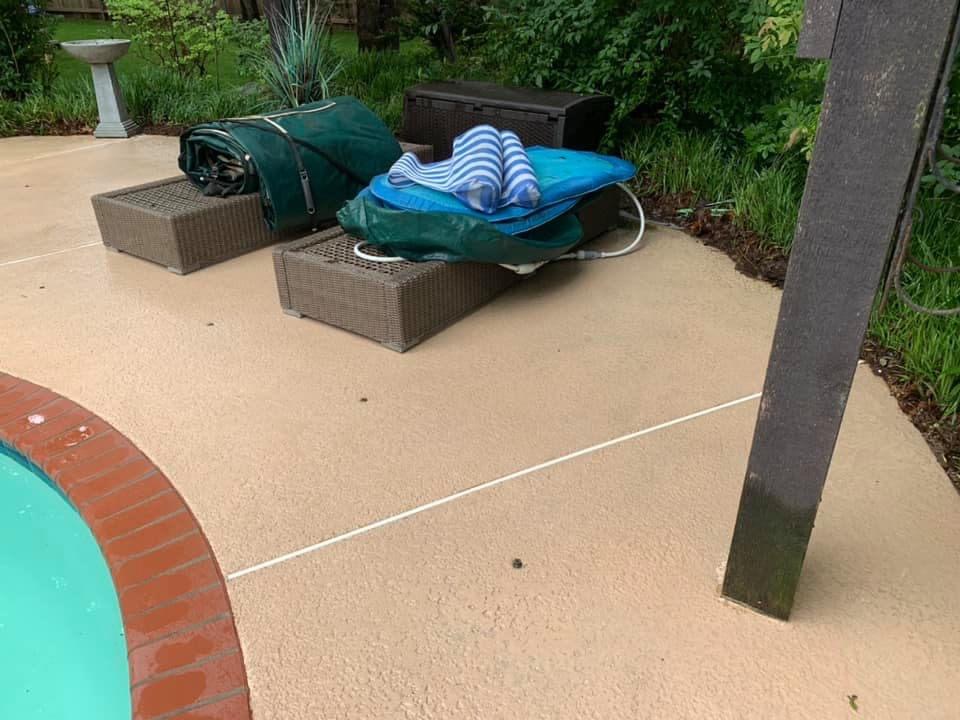
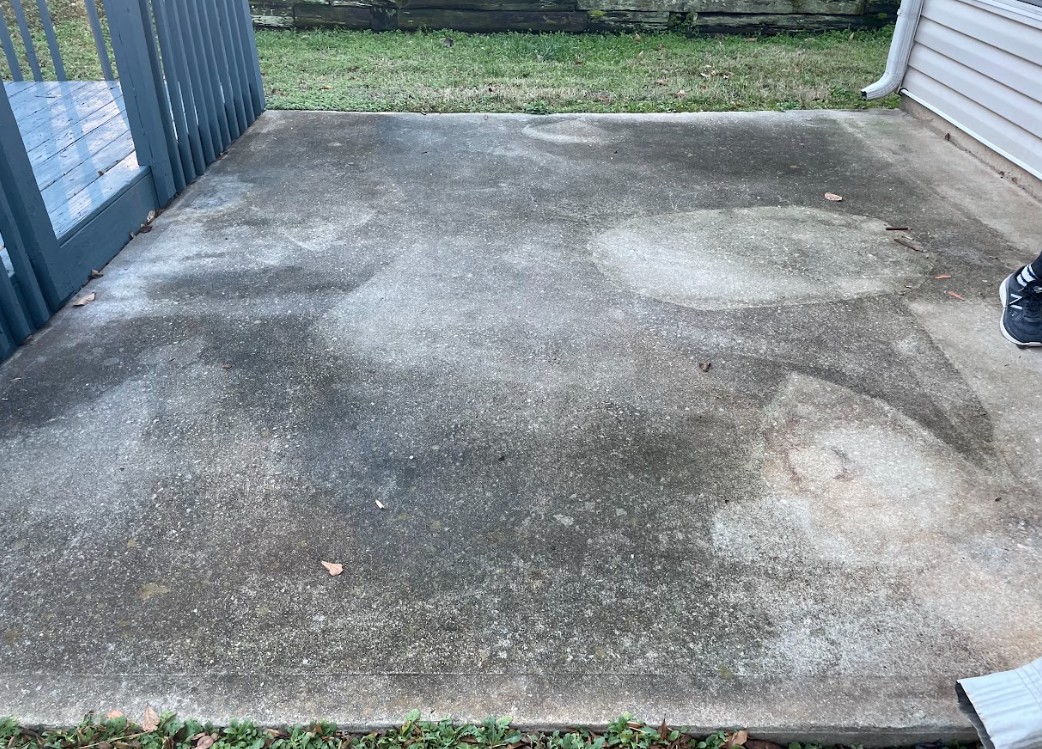
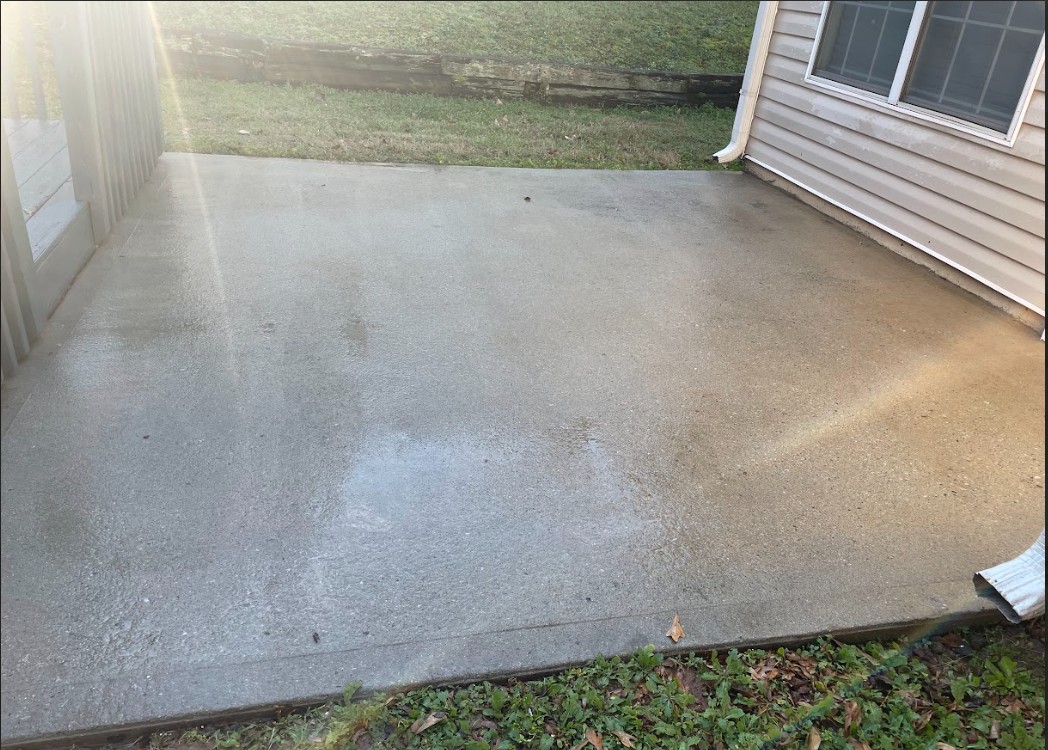
Each pair below is one visit on one surface, photographed before and after. Drag the handle to compare.

Pool deck before pressure washing Pool deck after pressure washing
Before After
Pool patio before pressure washing Pool patio after pressure washing
Before After
Concrete before pressure washing Concrete after pressure washing
Before After
Sequence

How is a pressure washing job sequenced?

A Thrare Contracting wash runs in seven steps, and the first two happen before any water moves.

  1. Walk and substrate call. The crew lead identifies the cladding, notes failed caulk, open penetrations, loose mortar, unpainted window frames and any coating already failing, and photographs anything that will be blamed on the wash afterward.
  2. Drain protection. Inlets in the runoff path are covered or bermed, and the recovery point is chosen from the slope rather than from convenience.
  3. Protection and pre-wet. Light fixtures, outlets, low vents and plantings are masked or saturated. Sika's bulletin states the reason plainly for coated walls: "It is recommended to keep lower elevations wet to prevent run-off from above from causing streaking."
  4. Chemistry and dwell. The mix is sized to the substrate and the growth, then given its dwell time. Extending dwell is the correct response to a stubborn surface. Raising pressure is not.
  5. Rinse, top down, in sections. James Hardie's bulletin puts it in one line: "It is always suggested to clean a small section at a time. Start from the top and work your way down to prevent dripping or streaking onto the cleaned area."
  6. Detail and recover. Edges, corners, downspout backs and thresholds get hand attention, and the held water is routed to its disposal path.
  7. Punch walk. The site contact walks the work with the crew lead before the truck moves, and anything missed is corrected on the same visit.

Two steps carry more weight than the rest. Step 1 decides which pressure ceiling from the table above governs the job, and step 2 decides whether the property is compliant while the work runs. A crew that starts at step 4 will produce a clean building and an unanswered question.

Scope

What is in the price and what is not?

A Thrare Contracting number covers the cleaning, the water handling the cleaning requires, and the protection around both.

In the number

Not in the number

Written this way for one reason: every line in the second list is a line competitors leave off a quote and add to an invoice. A buyer comparing two numbers is usually comparing two different scopes, and the difference is almost always water handling and revealed-condition repairs.

From You

What does Thrare Contracting need from a property before the crew arrives?

Seven items, and six of them are one line each.

Scheduling

What hours can an exterior cleaning crew work in metro Atlanta?

Working hours in metro Atlanta are set city by city, and none of the four ordinances Thrare Contracting schedules around names pressure washing.

CityWhat the code or the city publishesHow Thrare Contracting schedules to it
AtlantaSection 74-133 makes it unlawful to operate motorized landscape maintenance devices, "including but not limited to leaf blowers, lawn mowers, or chainsaws", in residential and mixed-use zoning districts or within 300 feet of one, "from 8:00 p.m. to 8:00 a.m." Section 74-134(a) leaves construction noise unrestricted between 7:00 a.m. and 7:00 p.m. on a weekday, and between 9:00 a.m. and 7:00 p.m. on a weekend day or legal holiday.Machine and blower work next to occupied buildings starts after 8:00 a.m. as Thrare Contracting's own practice. Exclusion 74-132(j) covers "manufacturing, governmental, or commercial entities in the normal course of their business", and whether that exclusion reaches 74-133 is an open question for the city, so the later hour is used rather than argued.
Sandy SpringsThe City's Code Enforcement Division publishes permitted hours for "Construction and commercial landscaping activities": Monday to Friday 7:30 a.m. to 7:30 p.m., Saturday 8 a.m. to 5 p.m., and "Sundays and holidays: No permitted hours". Work outside them requires a variance from the Community Development Department.Scheduling policy modeled on those published hours. The City's page is its own summary of common violations, cites no section number, and does not name pressure washing, so Thrare Contracting treats the window as policy rather than as a rule written for this trade.
AlpharettaSection 26-116(3) bars construction and demolition activity between 7:00 p.m. and 7:00 a.m. on weekdays, before 9:00 a.m. or after 5:00 p.m. on Saturday, and at any time on Sunday. Section 26-116(2) applies the same window to commercial landscaping power tools within 250 feet of a residential property line. Table 1 under 26-114(a) sets 60 dBA at a residential receiving line from 7:00 a.m. to 11:00 p.m. and 55 dBA overnight.The same window, as Thrare Contracting policy. Neither paragraph names exterior cleaning, so no claim is made that the ordinance governs this trade. Any overnight commercial work holds 55 dBA at a residential receiving line.
MariettaCity of Marietta Development Services publishes sound level limits by receiving property: 65 dBA and 84 dBC from 7 a.m. to 11 p.m., and 60 dBA and 79 dBC from 11 p.m. to 7 a.m.Daytime scheduling inside the higher band, with overnight commercial work quoted against the 60 dBA figure rather than assumed to fit under it.

The honest framing matters more than the hours. None of those provisions names pressure washing, power washing or exterior cleaning, so Thrare Contracting states the windows as its own scheduling policy modeled on what each city publishes, never as a compliance claim. Where a lease, an HOA covenant or a tenant agreement is stricter than the city, the stricter document wins and the schedule is written to it.

Frequency

How often should a metro Atlanta exterior be washed?

Rainfall, canopy and orientation set the interval, and metro Atlanta sits at the wet end of the national range.

NOAA's National Centers for Environmental Information publishes a 1991 to 2020 annual precipitation normal of 50.43 inches for station USW00013874, Atlanta Hartsfield International Airport, and 48.13 inches for station USW00003888, Atlanta Fulton County Airport. North of the perimeter the same dataset runs higher: 56.37 inches at Cumming 2N and 56.32 inches at Norcross. Each of those numbers is a station normal for a 30 year period rather than a total for any single year, and NOAA publishes no 1991 to 2020 annual precipitation normal for the Alpharetta station, so Cumming and Norcross bracket the north side rather than measure it.

Water plus shade is what grows the black film on a north elevation while the south wall of the same house stays clean. Under mature canopy, on a north or east face, or behind a fence that blocks afternoon sun, organic regrowth is visible again in months rather than years. Full sun on a west elevation buys considerably longer.

One counterweight belongs here for coated walls. Sika's Senergy bulletin states that "Frequent power-washing should be avoided, it may result in premature deterioration of the Senergy finish", so on EIFS and acrylic stucco a shorter interval is a cost rather than a benefit, and the correct answer is a gentler method on a longer cycle.

At Height

What rules apply when exterior cleaning happens above ground level?

OSHA publishes two different fall protection thresholds, and which one governs depends on how the work is classed.

Under 29 CFR 1910.28(b)(1)(i), the general industry rule, an employer must protect each employee on a walking-working surface with an unprotected side or edge that is "4 feet (1.2 m) or more above a lower level". Under 29 CFR 1926.501(b)(1), the construction rule, the same protection attaches at "6 feet (1.8 m) or more above a lower level". Thrare Contracting does not publish one of those numbers as "the OSHA rule", because the two rules are different and the classification decides which applies. Separately, 29 CFR 1910.28, paragraph (a)(2)(i), states that the section does not apply to portable ladders, which is exactly where most exterior cleaning exposure at height actually sits.

The practical consequence shapes the scope. Roof soft washing is done from the ground wherever reach allows, because chemistry rather than proximity does the work and a crew on a wet roof is the least defensible position on any exterior job. Second story elevations are reached with extended wands and ladders on stable ground. Where an elevation genuinely cannot be reached that way, lift work is quoted as its own line rather than absorbed silently.

One scope boundary is worth stating plainly on this page. Residential gutter cleaning is available from Thrare Contracting only as an add-on to a soft wash package, never as a standalone visit, because a ladder-only trip for a single gutter run is the worst risk-to-value ratio on the residential menu. Commercial gutter work is a different scope entirely and has its own page at commercial gutter cleaning in Atlanta.

On the Job

What does the work look like on site?

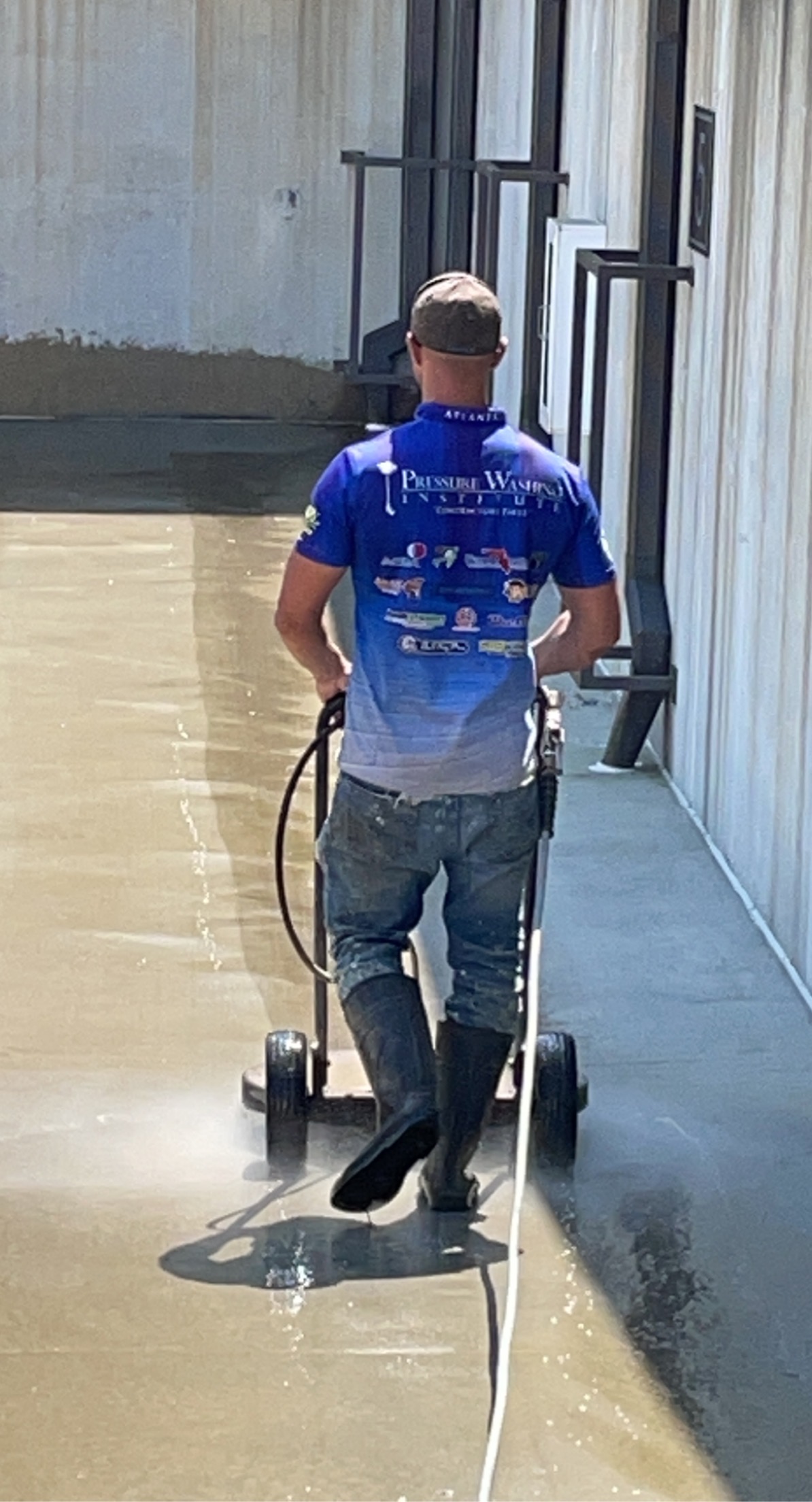
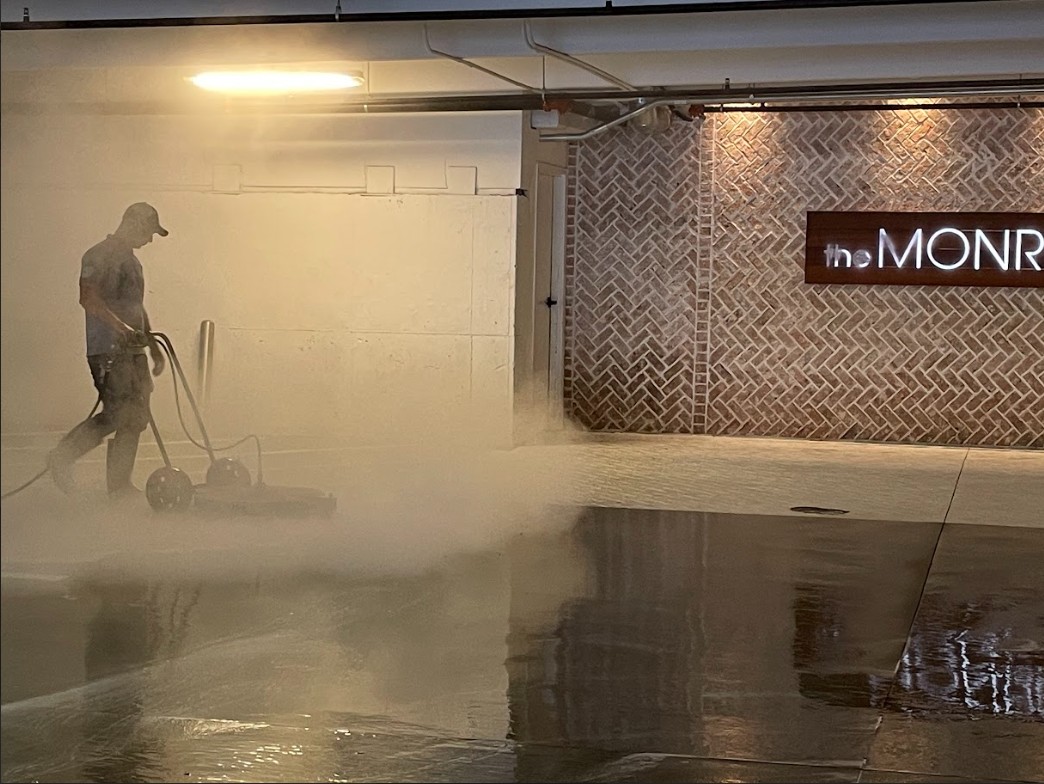
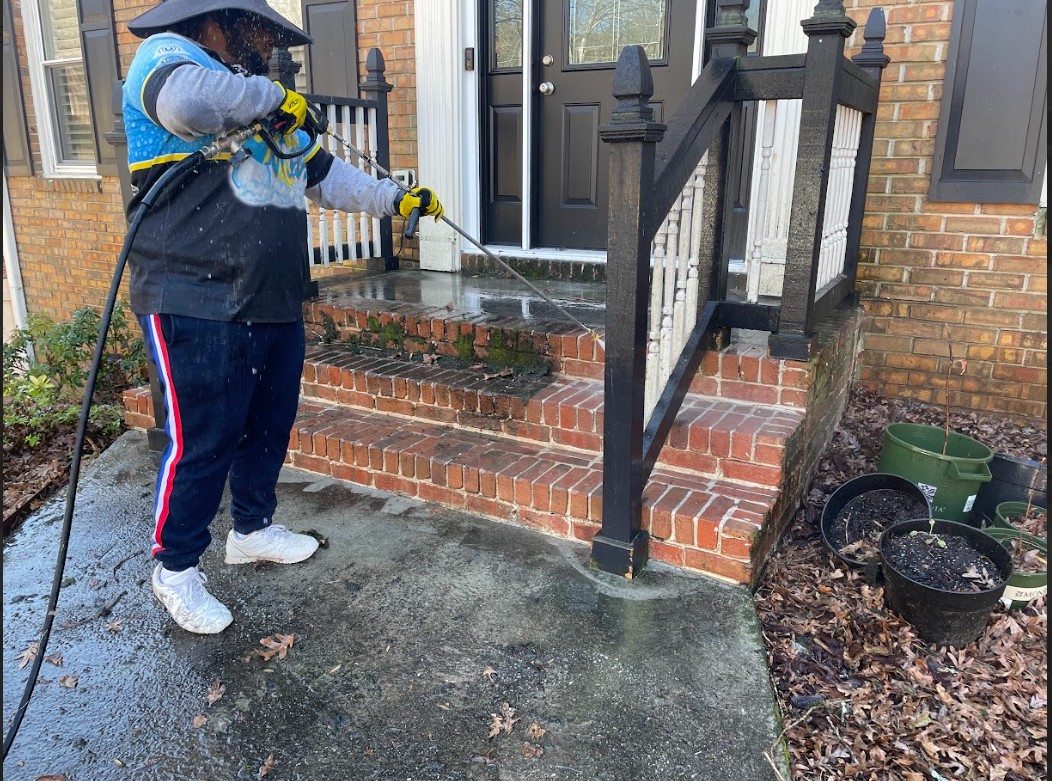
Surface cleaners on flatwork, controlled rinse on elevations, and a contained work zone.

Technician running a rotating surface cleaner on concrete flatwork Commercial exterior cleaning in progress Parking garage deck cleaning Front entry steps being washed
Verify Us

Which registrations and certifications can a buyer verify?

Every identifier below is checkable in a public registry without asking Thrare Contracting for anything.

Thrare Contracting is based in Atlanta and works the metro from one office at 8735 Dunwoody Pl, Ste R, Atlanta, GA 30350. Buyers who need a W-9, a certificate of insurance or a capability statement before onboarding a vendor can request all three in one message.

Where We Work

Which metro Atlanta cities have their own pressure washing page?

Twenty-one metro Atlanta cities have their own pressure washing page, and a city page is the right starting point whenever the property sits inside that city's limits, because the governing ordinance is the city's own.

What else runs on the same mobilization?

Free Estimate

Get your pressure washing estimate

Send your property details and we'll get back to you within 2 business hours on weekdays. No obligation.

Optional. We don't sell your number. Privacy Policy

We typically respond within 2 business hours on weekdays.

Frequently asked questions

Can pressure washing wash water go into a storm drain in Atlanta?

No. Atlanta City Code section 74-436 states that no person shall discharge, or allow others under its control to discharge, into the storm sewer system of the City of Atlanta any pollutants or waters containing any pollutants, other than stormwater, and section 74-428 lists detergents, degreasers, cleaning chemicals and yard wastes as pollutants. Thrare Contracting protects the inlets in the work zone and recovers the wash water instead of seeking a permit, because contained water is not a discharge.

What is the highest safe pressure for washing brick?

The Brick Industry Association's Technical Notes 20 instructs cleaners not to use water pressures higher than 400 psi as measured at the nozzle tip unless the brick manufacturer permits it, using a stainless steel 25 to 50 degree fan tip held a minimum of 12 inches from the surface, after a trial cleaning on a 20 square foot sample area. That figure is published for brick and does not transfer to fiber cement, EIFS or pavers, each of which has its own published limit.

Does Fulton County's stormwater ordinance apply to a City of Atlanta property?

No. Fulton County Government states that its Stormwater Management Program manages the surface water resources of unincorporated Fulton County, and that for all other areas of the County stormwater management is the responsibility of the individual cities. At a City of Atlanta address the governing instrument is Atlanta City Code Chapter 74, Article IX, which applies throughout the corporate limits of the City of Atlanta.

What is the difference between pressure washing and soft washing?

Pressure washing does the work mechanically with high pressure water and suits hard flatwork such as concrete driveways, walks and drive lanes. Soft washing does the work chemically at low pressure with dwell time and suits siding, roofs, painted surfaces, brick, stucco and EIFS. Sika states the principle for coated walls in one sentence: the chemicals provide the cleaning, not the water pressure. Thrare Contracting picks the method from the substrate rather than from the equipment already on the trailer.

Do you pressure wash both houses and commercial buildings?

Yes. Thrare Contracting works for homeowners, landlords and small rental portfolios, HOA and community association boards, and commercial property managers and facility teams across metro Atlanta. Residential work is house washing, driveways, roofs, decks and pool surrounds. Commercial work is building faces, entrances, breezeways, drive lanes and dumpster pads, sequenced around occupancy, and the commercial method detail lives on the commercial pressure washing page.

How early can a pressure washing crew start in Atlanta?

Thrare Contracting starts machine and blower work next to occupied buildings after 8:00 a.m. in the City of Atlanta as its own practice. Atlanta City Code section 74-133 makes it unlawful to operate motorized landscape maintenance devices in residential and mixed-use districts, or within 300 feet of one, from 8:00 p.m. to 8:00 a.m., while section 74-132(j) excludes commercial entities in the normal course of their business. Whether that exclusion reaches 74-133 is an open question for the city, so the later start is used rather than argued.

Sources

Where the regulatory and technical claims on this page come from

Every figure above is quoted from the document named below, as that document states it, on the read date given.

Two things are deliberately absent. Thrare Contracting publishes no Clean Water Act penalty dollar figure, because the number repeated across the trade web traces to secondary blogs rather than to the statute. Thrare Contracting also publishes no insurance limits, and hands a certificate to any buyer who needs them.

Call 678-748-3578 Free Estimate